


Posted by Anya Sleezer
Last Updated on: September 15, 2026
At a glance
The Mad Men, Don Draper playbook was simple: find the one thing only you offer, lead with it, and win. For decades it worked. It doesn’t anymore. Mid-sized brands used to compete by looking more capable than smaller players and faster than the giants, but AI now lets any competitor produce polished marketing and a professional website in an afternoon, so that edge is gone. The deeper problem is the differentiators themselves. Research on more than 1,200 business buyers shows buyers rarely pick a company for how it is different. They pick the one they already recognize and remember. Below, you will see why the differentiator loses its power, and how doubling down on what your brand stands for is what makes buyers choose you: distinctiveness, conviction, and proof. Written for marketing leaders and founders at mid-sized companies whose marketing looks great on paper but is not bringing in the business it should.
Differentiators Are Dead. Distinctiveness Isn’t.
Table of contents
What this does not mean
This is not a case for becoming generic and abandoning your differentiators completely. Just the opposite. What stopped working is the narrow version of differentiation: the single clever claim, the one feature only you offer, the unique selling point you lead with and expect buyers to reward. That move has lost its power. The fix is to pair it with belief, and lead with conviction. That is what makes buyers remember you and come back as loyal customers.
The advantage that just thinned out
Think about the position mid-sized companies used to hold. You looked more established and capable than the smaller players, and you moved faster and felt more personal than the national firms. That spread in the middle was real, and a good part of it came from simply looking more professional than the company one size down.
AI compressed that spread. Your bigger budget once bought the kind of polished design and sharp copy that set you apart from smaller competitors. That advantage is gone, because generative AI has pushed the cost of producing marketing, websites, and content close to nothing, and since everyone draws on the same handful of models, the output all starts to look the same. The polish that used to separate you no longer does, and customers no longer choose a company simply because its marketing looks competent. Competence is no longer your edge.
The real reason differentiators stopped working
For decades, the differentiator sat at the center of marketing strategy. This is the Mad Men playbook, the one Don Draper would pitch with a cigarette and a tumbler of scotch: find the one thing only you offer, lead with it, and win. For a long time it worked. Markets had fewer players, and a strong claim could stand for years before a competitor matched it.
Two things changed that.
- AI shortened the life of any claim to almost nothing.
- Buyers never chose you based on your differentiators in the first place.
The evidence is hard to argue with.
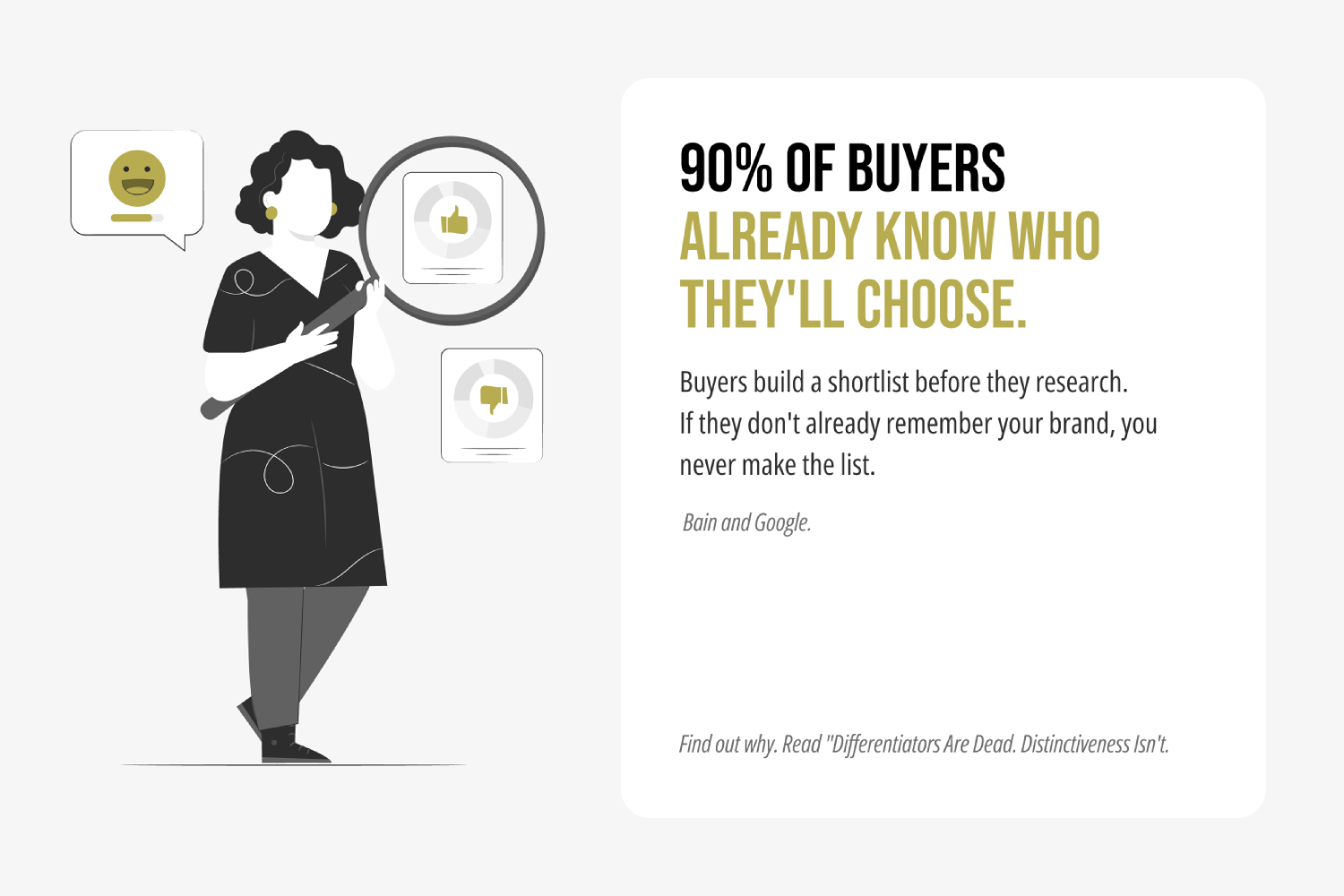
Buyers build their shortlist before they research. If they don’t already remember you, you never make the list. (Bain and Google)
80-90%
of business buyers choose from a shortlist they build before any research begins. If they don’t already remember your brand, you never make the list.
(Bain & Company and Google)
In a Bain and Google study of 1,208 business buyers, 80 to 90% already had a set of vendors in mind before they did any research, and about 90% picked a vendor from that original shortlist. Read that again. Buyers pick from their original shortlist before they read a single comparison, book a demo, or see your clever positioning. By the time they weigh their options, you are either a name they recognize, or you are not in the running.
That changes the purpose of your marketing. It does not exist to win an argument about why you are different. It exists to make you one of the few names a buyer remembers. Buyers don’t choose companies for being different. They choose the ones they recognize, trust, and believe in.
The reflex that will not save you
When our marketing is not landing, our trained instinct is to come up with a better differentiator or headline. A new angle. A claim no competitor has made yet. Find the unique thing, lead with it, win.
Think about how unreliable that is. In How Brands Grow, Byron Sharp and the Ehrenberg-Bass Institute argue for throwing your unique selling proposition out, on the grounds that customers do not care much whether a brand is different, and that differentiation rarely lasts because rivals copy it. Not every marketer agrees, and many argue meaningful difference still carries weight. But you do not have to abandon your differentiators to see the truth in what Sharp says. A feature claim is the easiest thing in your marketing for a competitor to match, and when anyone can generate a credible version of your message by lunch, the lead you get from “the thing only we do” lasts about a week.
Any competitor can produce professional marketing now. None can copy what your brand actually believes.
The good news is that the alternative is more effective and it compounds instead of expiring.
What gets you chosen now
Differentiators are easy to copy. Buyers choose the companies they can’t forget..
Three things take its place, and unlike a differentiator, they grow stronger the longer you hold them.
- Distinctiveness.
Be instantly recognizable. Differentiation is about product features that set you apart, while distinctiveness is about being easy to identify, unique and consistent across all touchpoints. Distinctiveness lands you on the shortlist, because a brand you recognize on sight is a brand you remember when the need arrives. Most mid-sized companies under-invest here, because consistency feels less exciting than a new angle. A few well-built brand assets used relentlessly will out-earn a clever campaign that looks like everyone else’s. - Conviction.
Hold a belief, do not just claim a feature. State it plainly enough that the wrong buyer rules themselves out and the right one leans in. A belief is the one thing a competitor cannot copy, which is why we created the RallyPoint, the core belief you build a brand around, and why it makes a brand story start working. - Proof.
Skeptical buyers want substance, not assertions. Edelman and LinkedIn found that 71% of buyers consider thought leadership more effective than traditional marketing and sales material at showing a vendor’s value, and 64% trust it more than product sheets and brochures. Show your thinking. Show social proof. Show the work. Conviction you can demonstrate reads as real in a way a claim never will.
The Distinctiveness Playbook
You do not have to overhaul everything. You just must redirect your effort.
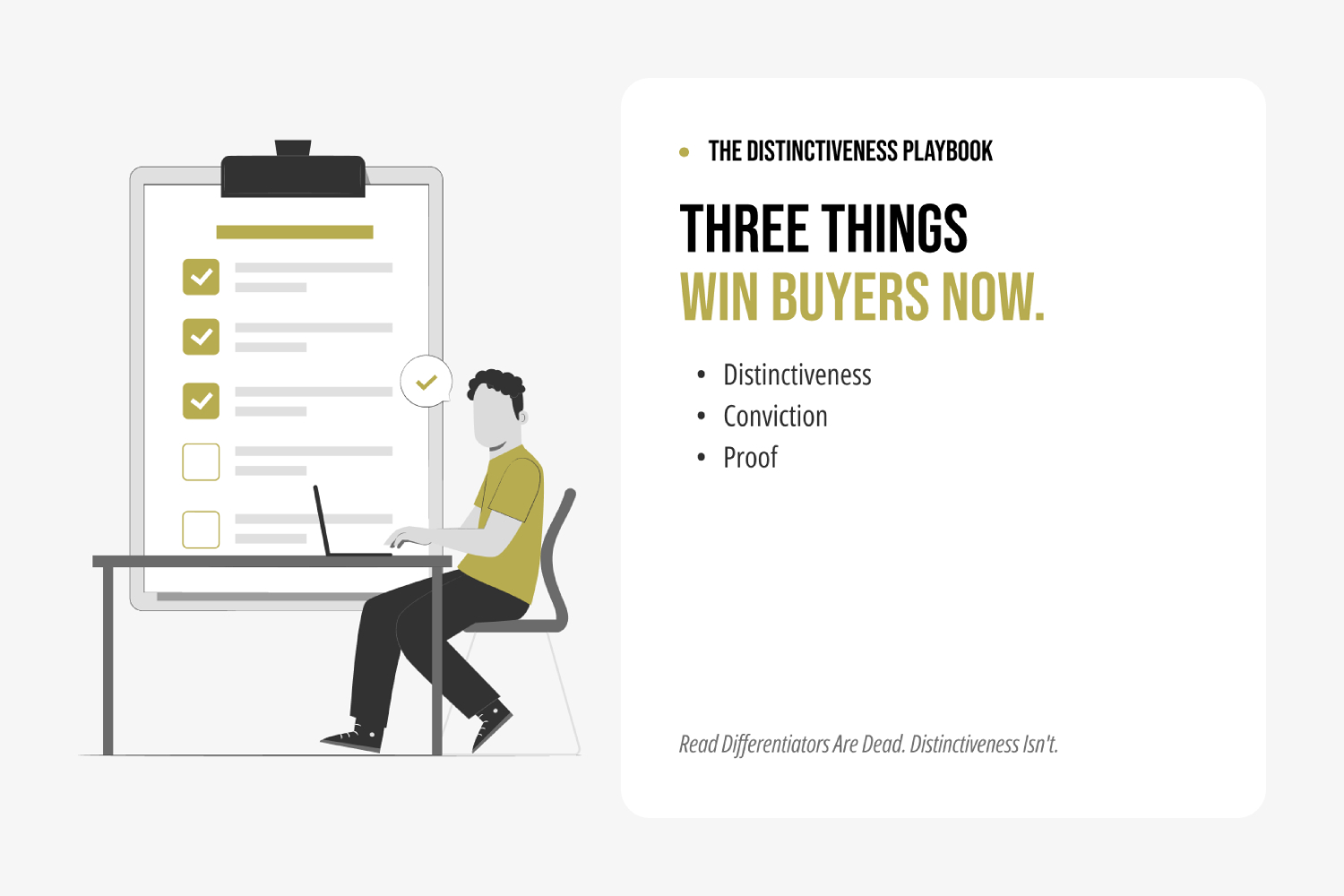
Three things win buyers now: distinctiveness, conviction, and proof.
Brand.
Any competitor can claim the same adjectives. Lead with what you believe instead.
Stop opening with adjectives any competitor could claim, like trusted, innovative, or results-driven. Lead with what you believe and who you serve. If you do have a real, provable difference, keep it, but treat it as one line inside a recognizable brand, not the whole strategy. Then pick a small set of distinctive assets, your look, your voice, a few signatures you own, and repeat them until buyers know them on sight. Repetition builds recognition. Reinvention erases it.
Website.
Lead with proof, conviction, and distinctiveness, not just beauty and polish. Good design still matters, but it is the price of entry now, not the thing that sets you apart. Make the first screen say what you stand for, and fill the rest with proof, so your website earns attention instead of just looking the part.
Content.
Stop publishing the safe, forgettable content that sounds like everyone else in your category. Publish a point of view only you would put your name to. Say something real and meaningful, even if it is not for everyone. There is evidence this works: when Italy briefly banned ChatGPT in 2023, small-business marketing grew measurably less uniform. Engagement rose about 3.5% because the content stopped sounding like everyone else’s.
The part competitors cannot copy
Your biggest advantage is the one thing competitors and AI cannot copy: a real belief. One you make recognizable and prove over time, that no one can buy, borrow, or fake.
Your job is not better marketing. It is giving buyers a clear reason to remember and believe you.
Give buyers a clear reason to remember and believe you. That’s the one thing AI can’t hand your competitors.
If your marketing is technically good but still is not landing, that gap is probably the reason. The good news is that it is fixable. If you want a second set of eyes on where your brand sits between forgettable and distinct, book a free 30-minute consult.
Not sure where your brand lands between forgettable and distinct? Let’s find out together.
Want to see where your brand actually stands?
Let’s look at it together. At Levo, we help mid-sized and mission-driven brands clarify what they stand for, make it unforgettable, and turn it into marketing customers remember. If your marketing looks good but buyers still aren’t choosing you, let’s figure out why.
Book your free 30-minute consult. No pitch. No pressure. Just clarity.
FAQs
Are brand differentiators really dead?
The feature-based differentiator, the single claim that you do something no one else does, has lost most of its power. Buyers do not use it to choose, and competitors copy it fast. What replaces it is distinctiveness and conviction, which resist imitation and compound over time.
What is the difference between differentiation and distinctiveness?
Differentiation is about product features that make you different. Distinctiveness is about being easy to recognize and recall, through your name, look, voice, and consistent style. Research from the Ehrenberg-Bass Institute finds that distinctiveness drives choice more reliably than feature differences.
Does this mean branding and positioning no longer matter?
The opposite. The durable part of branding, a clear belief you make recognizable, matters more than ever. What has lost its value is the clever claim. Replace it with a consistent, honest conviction.
If every competitor has the same AI tools, what separates one brand from another?
The judgment and belief behind the tool. When tools, tactics, and even products get copied overnight, conviction is the one advantage competitors cannot steal. AI can research, draft, and produce. You decide the point of view, the tone, and what to cut. The brands that win direct AI with their beliefs and expertise. The tool is shared. The discernment is not.
How do we know if our marketing is forgettable?
Try this test. Take your homepage or a recent post, cover your logo and name, and ask whether a stranger could tell it was you. If not, you have a distinctiveness gap. Flat engagement on otherwise solid content is the second clue.
Sources
- Bain & Company and Google, “What B2Bs Need to Know About Their Buyers,” Harvard Business Review (survey of 1,208 US business buyers)
- Byron Sharp and Jenni Romaniuk, Ehrenberg-Bass Institute for Marketing Science, How Brands Grow and “Differentiation versus distinctiveness”
- Edelman and LinkedIn, B2B Thought Leadership Impact Report
- Liu, Wang, and Yang, “Generative AI and Content Homogenization: The Case of Digital Marketing,” SSRN
- Neil Patel, NP Digital, on brand as the lasting advantage in an AI market
