


- All
- Advertising + Marketing
- Branding
- Case Studies
- Environmental Design + Tradeshows
- Mission-Driven Marketing
- SEO, GEO + Digital Marketing
- Web Design + Development
Is your advertising and marketing strategy working?
Take our short, free audit to assess the strength of your ad and marketing campaigns.
Take Free Audit
Posted by Anya Sleezer
Last Updated on: September 16, 2026
Table of contents
- At a glance
- When nothing is broken but nothing is working
- What the alignment gap actually is
- The five signals that have to tell one story
- What misalignment really costs you
- The new stakes: misalignment makes you invisible to AI
- The single-story test
- The one job only you can own
- FAQs
- Let’s close your alignment gap
At a glance
You can fix your website, sharpen your ads, and refresh your brand, and still watch the numbers slide. The real problem usually isn’t any one piece. It’s that your brand, website, and campaigns are telling slightly different stories, and that mismatch is the hidden cause behind the symptoms you’ve been treating one at a time: the bounce, the funnel leak, the campaign that won’t convert. A leak tells you where you lose people. The alignment gap tells you why.
What you’ll learn
- Why fixing the weakest piece is usually the wrong move
- The five signals that have to tell one story
- What misalignment really costs you, in trust, conversions, and AI search
- A one-hour test to find your own gaps
- Why no single vendor can close the gap for you
This is for VPs of marketing, marketing directors, founders, and CEOs whose marketing looks right on paper but isn’t pulling its weight.
When nothing is broken but nothing is working
Your brand is good. Your website is good. Your campaigns are good. But for some reason, your marketing still isn’t working like it should.
You may have an agreement problem.
When growth slows, most teams go looking for the weak link. They redesign the website, rework the ads, or start talking about a rebrand. All reasonable moves. All built on the same assumption: that one piece is broken.
But often, nothing is. The brand is solid, the site is solid, the campaigns are solid, and they’re still costing you business because they don’t tell the same story. That’s the alignment gap. It’s one of the most common and most expensive problems in mid-sized marketing, because it hides behind work that looks fine.
What the alignment gap actually is
The marketing alignment gap is the distance between what your brand, your website, and your campaigns each say about who you are.
When they say the same thing, it adds up. Every touchpoint makes the next one more believable. When they don’t, they cancel each other out. The ad earns the click. The website quietly undercuts it. The visitor leaves and never knows why.
This isn’t the same as a leak. When results dip, most teams run a funnel review to find where people drop off. That’s useful work, and it’s the kind of thing we cover in our guide to finding the hidden marketing leaks costing you customers. But a leak tells you where you’re losing people. It doesn’t tell you why. A lot of the time, the why is that the brand, the website, and the campaign someone just moved through were telling them three slightly different stories. That’s the gap. And it’s usually the reason the leak is there in the first place.
The five signals that have to tell one story
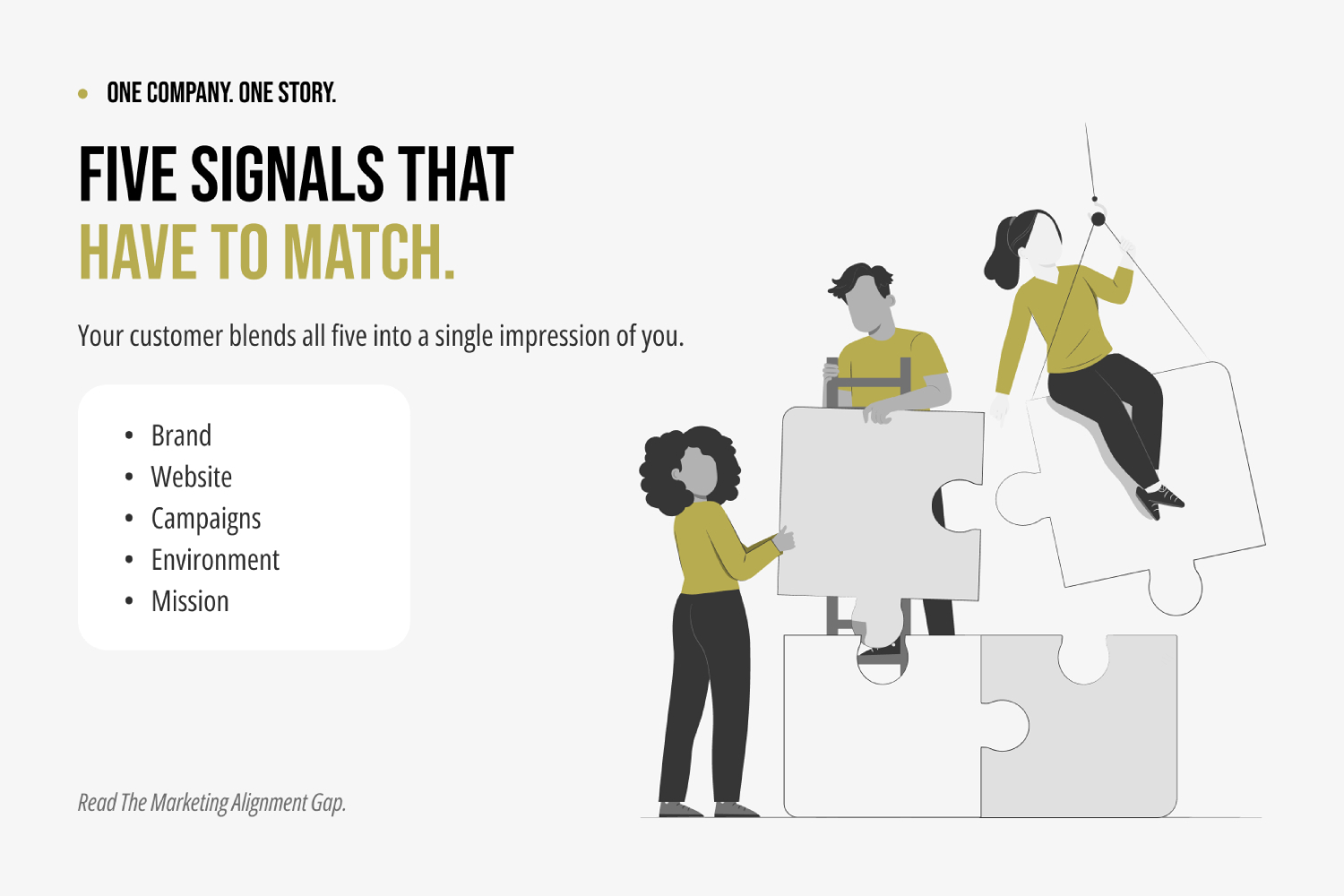
Your customers don’t experience your marketing in neat categories. They get all of it at once. An ad in the morning. Your website that night. Your booth at a conference. A post in their feed. They blend it into one impression of you.
For a mid-sized business, five signals carry most of that impression. They all need to tell the same story.
- Brand.
Who you are, who you’re for, and what you stand for. - Website.
The proof. Where the promise holds up or falls apart. - Campaigns.
The promises you make in ads, search, and social to earn attention. - Environment.
The in-person version of you. The booth, the signage, the space. - Mission.
The belief behind why you exist. It should direct the other four, not just sit on your About page.
When these line up, it builds. As Sprout Social puts it, consistent messaging means whoever runs into your ad, your post, or your landing page walks away understanding the same company. When they don’t line up, people feel it, even if they can’t say what’s wrong. The ad says boutique and personal. The website feels corporate and cold. The booth looks like a third company. Each piece might be well made. Together, they create doubt.
The brand you built in your brand story gets undercut by a website that was planned in isolation. Good work, all pulling in different directions.
What misalignment really costs you
Buyers read consistency as competence. They read contradiction as risk. And in a considered B2B purchase, risk is what kills the deal.
Consistency isn’t a soft, nice-to-have thing either. It shows up in revenue.
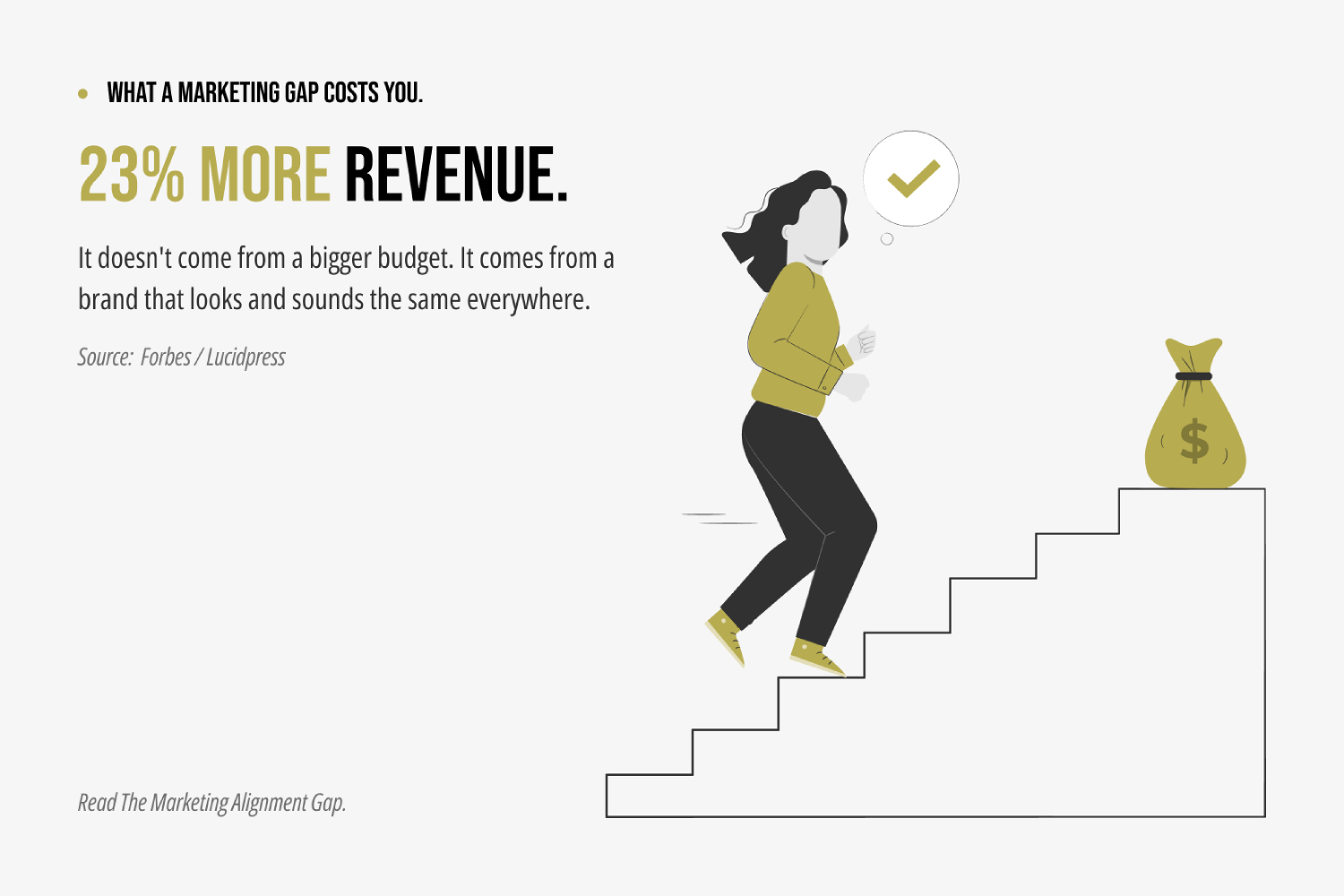
23%
higher revenue can come from presenting a brand consistently across every platform. The lift comes from consistency itself, not a bigger budget. (Forbes / Lucidpress, now Marq)
Most companies already know this, which is the frustrating part. About 95% have brand guidelines. Only around 30% actually use them. That space between having standards and living by them is exactly where the money leaks out.
It hits hardest at the moment of conversion. Someone clicks an ad that promises one thing, lands on a page that delivers something a little different, and the trust you just earned is gone, right when you needed it most.
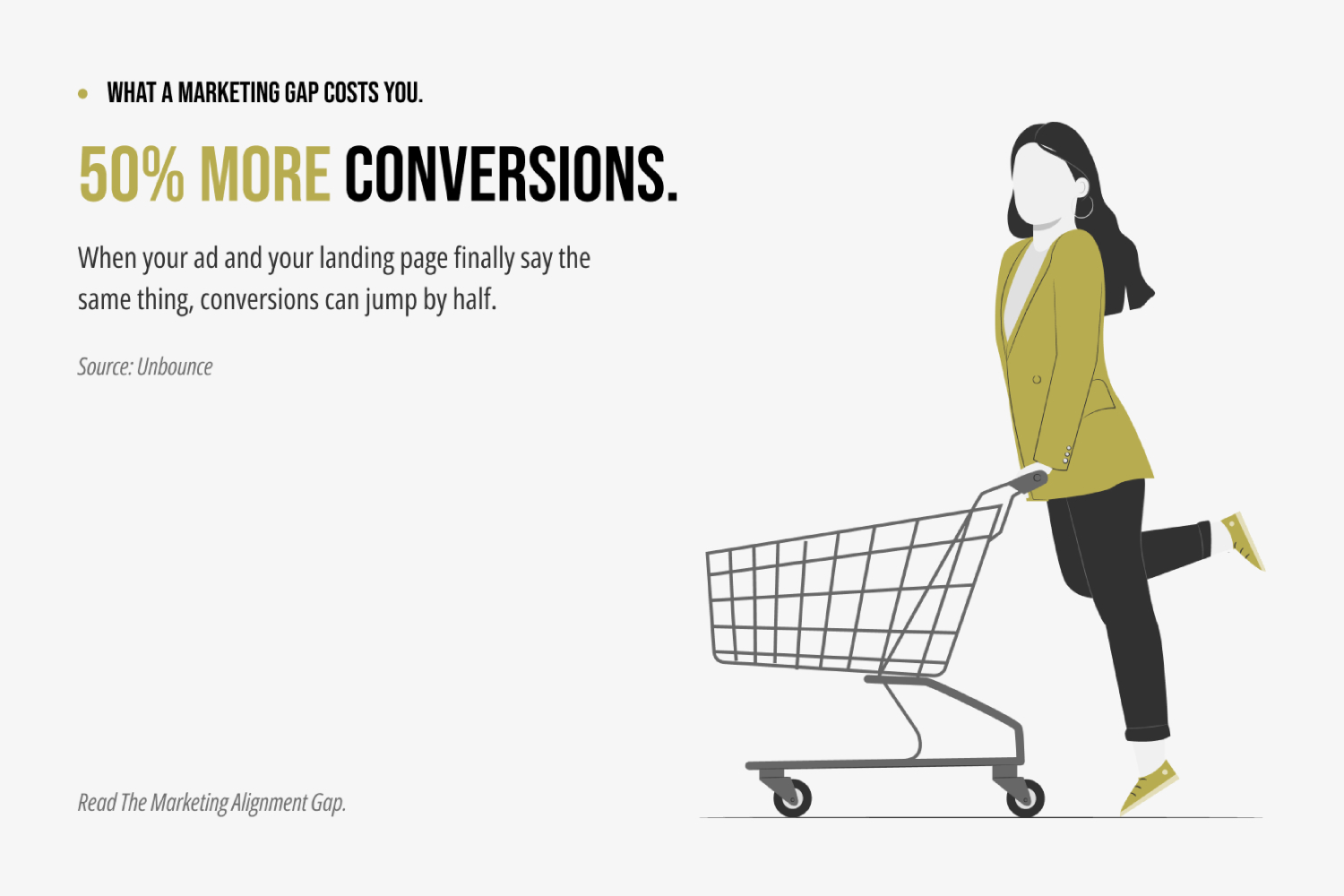
50%
higher conversion rates can come from strong message match between an ad and the page it lands on. When the promise and the page agree, fewer people leave. (Unbounce)
We call the payoff for getting this right the coherence premium. It isn’t a new project or a new line item. It’s a better return on the brand, website, and campaigns you’re already paying for.
The new stakes: misalignment makes you invisible to AI
For years, this was only a human problem. Mixed signals confused buyers. Now they confuse machines too, and that’s the part most teams haven’t caught up to.
AI search tools like ChatGPT, Google’s AI Mode, and Perplexity don’t read your site page by page anymore. They pull from across the web and build one picture of who you are, based on how you’re described everywhere you show up. When those descriptions agree, the AI treats it as fact and is far more likely to name you. When they contradict each other, it isn’t sure what to believe, and the brands it isn’t sure about get left out of the answer.
We went deep on this in your website vs. AI. The short version: SEO gets you ranked. GEO gets you cited. In an AI answer, there’s one response and a handful of sources. You’re either one of them or you’re invisible. A scattered, contradictory brand doesn’t just convert worse now. It’s harder for AI to understand, which makes it easier to skip.
The single-story test
You don’t need a big audit to start. You need about an hour and some honesty.
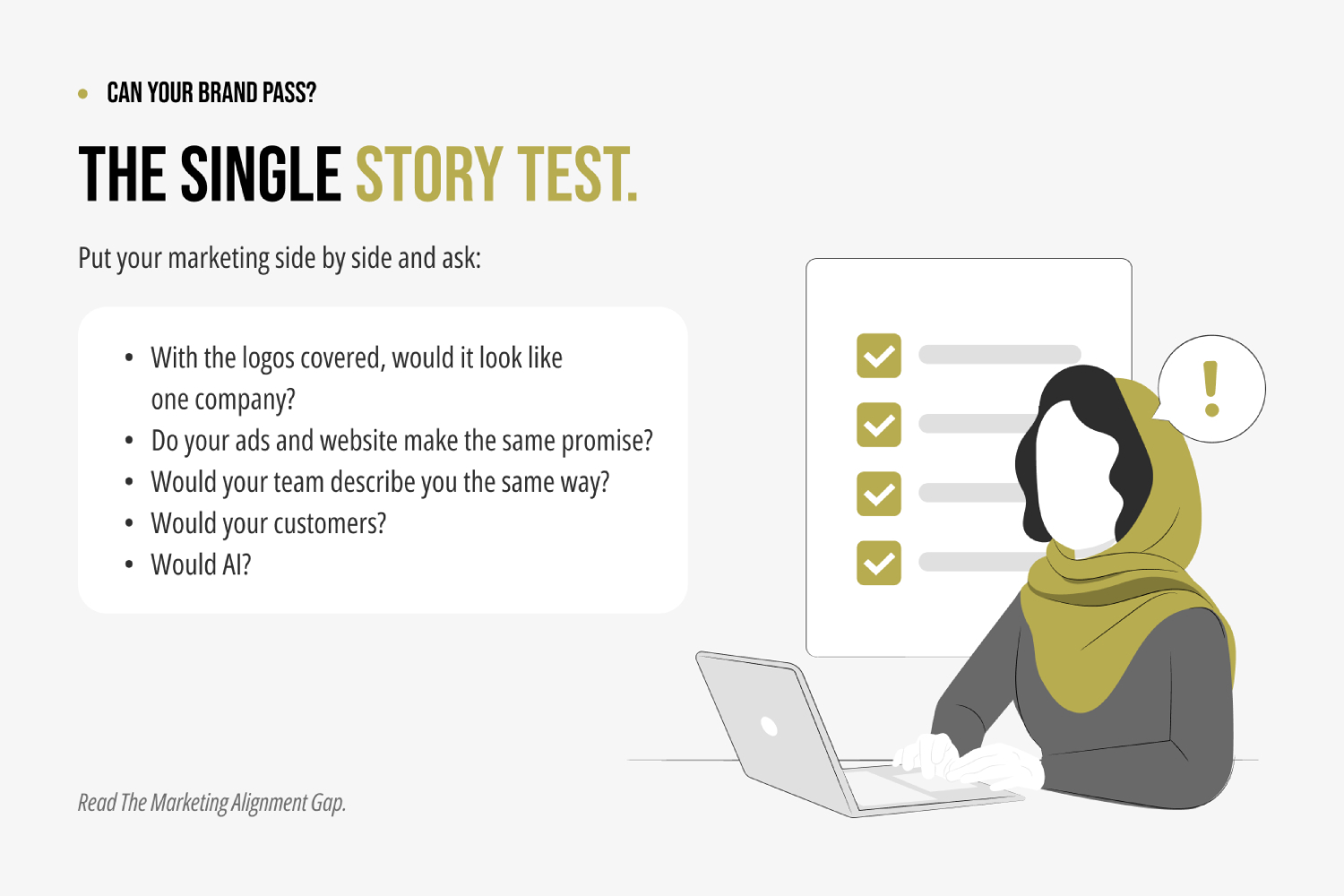
Pull up your most-run ad, your homepage, a key landing page, your recent social posts, and a photo of your booth or signage. Put them side by side and ask:
- Would a stranger believe these all your logos came from the same company?
- Does what your ads promise match what your website delivers in the first ten seconds?
- Ask five people on your team to finish “We help ___ do ___.” Do you get one answer or five?
- Ask a few recent customers to describe what you do and why they chose you. Does their answer match the story you’re trying to tell?
- Ask ChatGPT or Google’s AI what your company does and who it’s for. Does the answer match how you’d describe yourself?
- Does your #RallyPoint, the core belief your brand stands for, actually direct your decisions, your design, and your campaigns? Or is it just words on your About page?
Anywhere you hesitate, you’ve found a gap. Take our free alignment audit and we’ll show you where your signals agree and where they’re working against each other with a clear scorecard and recommendations on where to improve.
The one job only you can own
This isn’t about effort. Marketing teams coordinate constantly, share calendars, and know everything is supposed to line up. The gap opens anyway, because the day belongs to the work around the work. Asana’s Anatomy of Work Index found that knowledge workers spend about 58% of their time on coordination, status updates, and chasing approvals, and less than 10% on strategy. Add deadlines, more channels and tools than ever, and a dozen handoffs, and small inconsistencies slip through the seams. Not from carelessness, but from how the work actually gets done.
An outside vendor sits even further out. They only know what you tell them, and they see the one slice they were hired for. Hand a new agency a single lane and it will sharpen that lane, but it won’t catch the gaps between lanes any better than the people already inside. Give a good one the whole picture, though, and that changes. Fresh, experienced eyes working from outside your day-to-day bubble will often spot the drift you’ve stopped being able to see.
Spotting the gap is one job. Owning it is another, and that one is yours. A partner can hold up the mirror, but no one else can keep your brand, website, campaigns, space, and mission telling a single story week after week. Whether you’re the CMO, the VP of marketing, or the founder still wearing the marketing hat, that is the part of the job no one can do for you. Unfortunately, this is also the first thing the role crowds out. The remit keeps widening, the pressure to prove ROI never lets up, and the cross-cutting view, the one that catches the gap, is the work that never has a deadline. It doesn’t help that the average CMO now has one of the shortest tenures in the C-suite, around four years, so the person meant to hold the story steady often hasn’t been there long enough to feel it drift.
What moves your numbers isn’t one more polished campaign.
It’s someone keeping the whole story aligned across every lane, on purpose.
That’s the level you work at, and it’s the level we work at too. The partners worth your time aren’t the ones who hand you another deliverable. They’re the ones who help you hold the whole thing together.
FAQs
What is the marketing alignment gap?
The marketing alignment gap is the distance between what your brand, your website, and your campaigns each say about your company. When those signals don’t match, customers read it as risk and AI search tools read it as confusion. That drags down trust, conversions, and visibility, even when every piece is well made on its own.
Isn’t that just a marketing funnel leak?
No. A leak is a spot where people drop off on the way to a purchase. An alignment gap is a contradiction between things someone sees at the same time, like an ad and the page it points to. A leak tells you where you lose people. The gap usually tells you why.
Does brand consistency really affect AI search?
Yes. AI tools build one profile of your brand from how you’re described across the web. Consistent signals make that profile clear and easy to cite. Contradictory ones make it fuzzy, and fuzzy brands get left out of AI answers. In AI search, consistency isn’t polish. It decides whether you show up at all.
How do I know if my brand, website, and campaigns are misaligned?
Run the single-story test. Put your ad, homepage, landing page, social, and signage side by side with the logos hidden, and ask whether a stranger would believe they’re one company telling one story. If you hesitate, you’ve found a gap. A formal audit maps it in more detail.
Do we have to rebuild everything to fix it?
Usually not. Most gaps close by aligning the story across what you already have. Tighten the message match, use consistent language, and make the proof match the promise. The goal is one throughline, which is normally faster and cheaper than starting over.
Let’s close your alignment gap
More marketing isn’t always the answer. Alignment is. When it all tells one story, buyers believe you and AI recommends you. You already have the pieces. They just need to agree.
Want to see where your brand, website, and campaigns line up, and where they don’t? Book a free 30-minute consult and we’ll walk your alignment gap together.
Sources
- Forbes / Lucidpress (Marq) State of Brand Consistency: the up-to-23% revenue figure and the brand-guidelines usage gap.
- Unbounce: message match between ad and landing page conversion lift.
- Sprout Social: consistent cross-channel messaging.
- Search Engine Land and Lumar: entity consistency and AI citation in generative search.
- Spencer Stuart 2025 CMO Tenure Study: average CMO tenure of about four years, among the shortest in the C-suite.
- Asana Anatomy of Work Index: share of the workday spent on coordination (“work about work”) versus strategy.
Is your advertising and marketing strategy working?
Take our short, free audit to assess the strength of your ad and marketing campaigns.
Take Free Audit
