


- All
- Advertising + Marketing
- Branding
- Case Studies
- Environmental Design + Tradeshows
- Mission-Driven Marketing
- SEO, GEO + Digital Marketing
- Web Design + Development
How effective is your digital marketing, really?
Take our quick free audit to discover if your digital marketing, SEO and GEO are underperforming, and what to do next.
Take Free Audit
Posted by Anya Sleezer
Last Updated on: June 11, 2026
At a Glance
If your organic traffic is declining but your rankings look fine, you’re measuring the wrong thing. AI search has quietly changed what ‘visibility’ means and most mid-sized marketing teams are still measuring AI-era visibility with pre-AI metrics, even when they know the landscape has changed. This article is for Marketing VPs, Directors, and founders who want to understand the shift, recalibrate their approach, and position their brand to win in both traditional and AI-driven search.
What you’ll learn:
- Why ranking #1 no longer guarantees the visibility it once did
- What GEO (Generative Engine Optimization) is and why it matters right now
- The new metrics that actually reflect brand visibility in 2026
- Three strategic moves your marketing team can make immediately
- Why this is a first-mover window — not a permanent open door
Table of Contents
Something strange is happening in marketing dashboards across the country.
Rankings are holding steady. SEO audits come back clean. Keyword positions haven’t moved. And yet, traffic is down. Leads are thinner. The phones aren’t ringing the way they used to.
If this sounds familiar, you’re not imagining it. And you’re definitely not alone. In fact, it’s one of the most common patterns we uncover when auditing underperforming marketing programs. The metrics look fine on the surface, but the underlying visibility engine has shifted.
The issue isn’t your SEO. The issue is that the definition of ‘ranking,’ and what it means to be ‘visible’ online, has fundamentally changed. And most marketing teams are still using last decade’s metrics to navigate a completely different landscape.
Search has entered a new era. It’s called AI search. And it doesn’t play by the old rules.
The Old Definition of ‘Ranking’ and Why It’s No Longer Enough
For 20+ years, ranking well in search meant one thing: your link appeared near the top of a list of ten blue links. Users scrolled down, found your result, clicked it, and landed on your website. The entire system was built around that click.
So that’s what we optimized for. Keywords. Backlinks. Page speed. Title tags. Domain authority. All of it. Every tactic, every report, every monthly retainer is designed to earn that click.
It worked. And it still works, partially. But search has changed structurally.
60%
of Google searches in 2026 end with zero clicks. These users get their answer directly from AI without ever visiting a website. (Semrush, 2025–2026)
AI-powered tools like Google AI Overviews, ChatGPT, Perplexity, and Microsoft Copilot, now synthesize answers and deliver them directly on the results page. Users increasingly never need to click through to your site. They get what they came for before they ever see your link.
Google AI Overviews now appear in 25% of searches (up from 13% in early 2025, per Conductor’s analysis of 21.9 million searches). ChatGPT has surpassed 800 million weekly active users as of October 2025, doubling from 400 million in February 2025 (OpenAI). Perplexity, Claude, and Gemini are all growing. And the click-through rate for a #1 organic result when an AI Overview is present drops to just 2.6%.
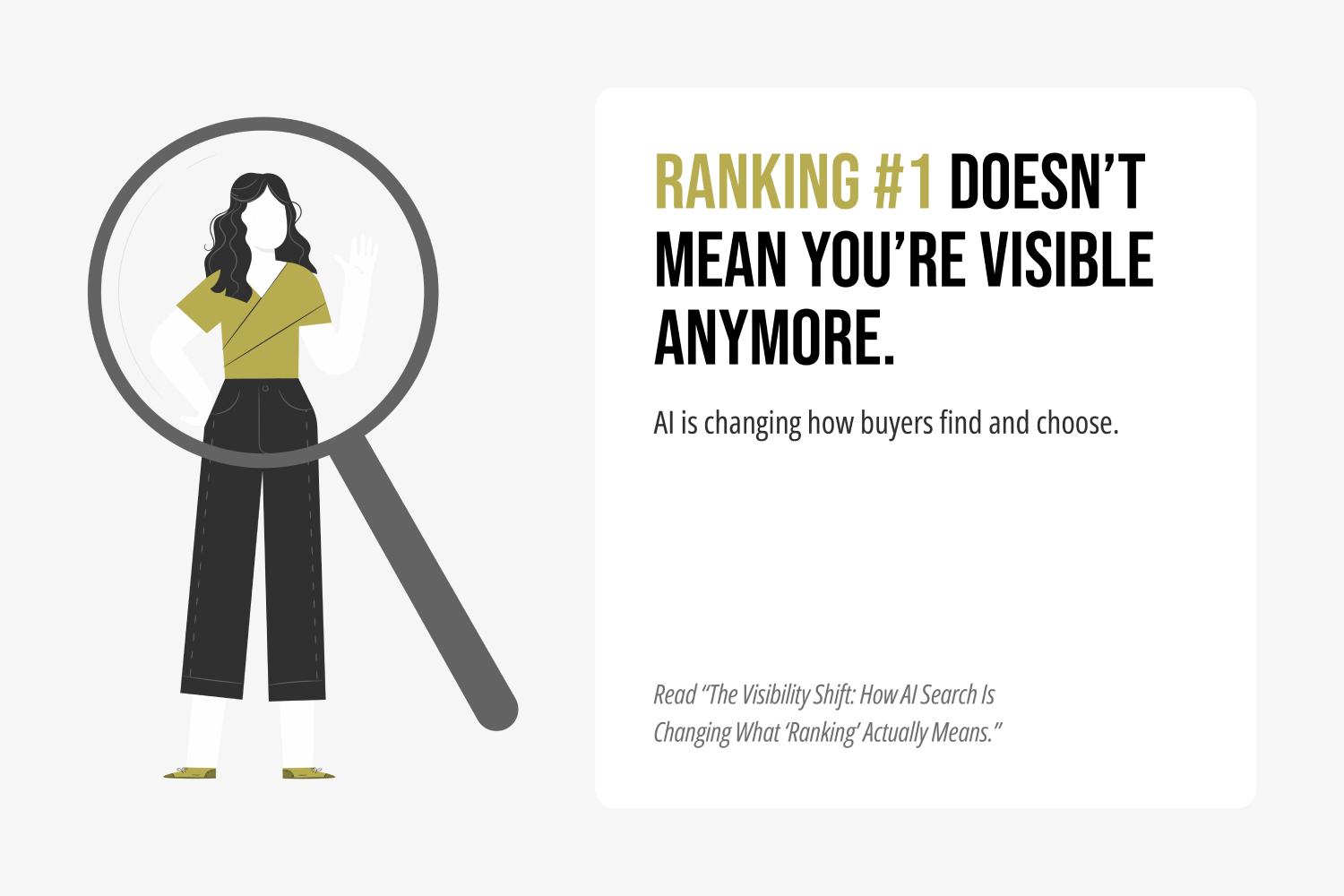
Read that last number again. Position #1, the goal your team has been working toward, only delivers a 2.6% click rate when AI answers the question first.
2.6%
click-through rate at position #1 on Google when an AI Overview is present, making citation presence more valuable than rank position alone. (Incremys, 2026)
That’s not an SEO failure. That’s a measurement failure. The old dashboard is telling you you’re winning a game that has quietly changed its scoring system.
What ‘Visibility’ Actually Means Now
Here’s the reframe that changes everything for mid-sized marketing leaders:
Visibility used to mean your link is near the top of the list.
Visibility now means your brand is one of the cited sources inside the AI-generated answer that’s recognized, recommended, and trusted by the system your buyers just asked for help.
That’s a fundamentally different thing. And it requires a fundamentally different strategy.
The new goal is to be one of the two or three brands that AI consistently recommends when your ideal buyer asks a question in your category. Not to rank in a list of ten. Not to win a single keyword. To be the answer, cited by name, in your industry and product space, across the platforms your buyers already trust.
In AI search, there is no list of ten results. There is one synthesized answer, typically drawing from three to eight sources, and either your brand is one of those cited sources, or you are invisible to that user.
For example, for Levo, success would mean that when a VP of Marketing asks ChatGPT, “What are the best strategic marketing agencies for mid-sized businesses?” our name shows up in that answer. Not because we advertised, but because we’ve built the kind of authority, relevance, and trust that AI systems recognize and surface.
That’s the real goal. That’s what GEO: Generative Engine Optimization is designed to achieve. It’s the discipline of structuring your content, your brand authority, and your digital presence specifically to be cited inside AI-generated answers, not just ranked in link lists.
The distinction is not semantic. The strategies are meaningfully different.
The old search funnel vs. the new influence funnel
| Traditional SEO Funnel | AI Search Influence Funnel |
| Rank #1 | Brand is cited in AI answer |
| User sees your link | User absorbs your brand’s answer |
| User clicks to your site | User builds trust without clicking |
| User converts (hopefully) | User chooses you when they’re ready to buy |
Notice what’s different in the AI funnel: the user never visits your site and yet your brand still shaped their decision. That’s a profound shift in how influence works.
And here’s the data that makes this critical for mid-sized businesses specifically: visitors who arrive from AI-generated referrals convert at twice the rate of traditional organic visitors, in one-third the sessions, according to Knotch data cited in the Conductor 2026 AEO/GEO Benchmarks Report. Semrush’s broader cross-industry analysis puts the conversion advantage at 4.4x, with some B2B SaaS studies reporting even higher multiples. AI-referred buyers are more qualified. They’ve already absorbed your brand’s message before they click. When they do arrive, they arrive ready.
The Three Metrics Your Dashboard Is Missing
If your marketing reporting was built in the last decade, it was built for a click-based world. It measures rank positions, organic sessions, click-through rates, and bounce rates. All of these things still matter, but they are now incomplete.
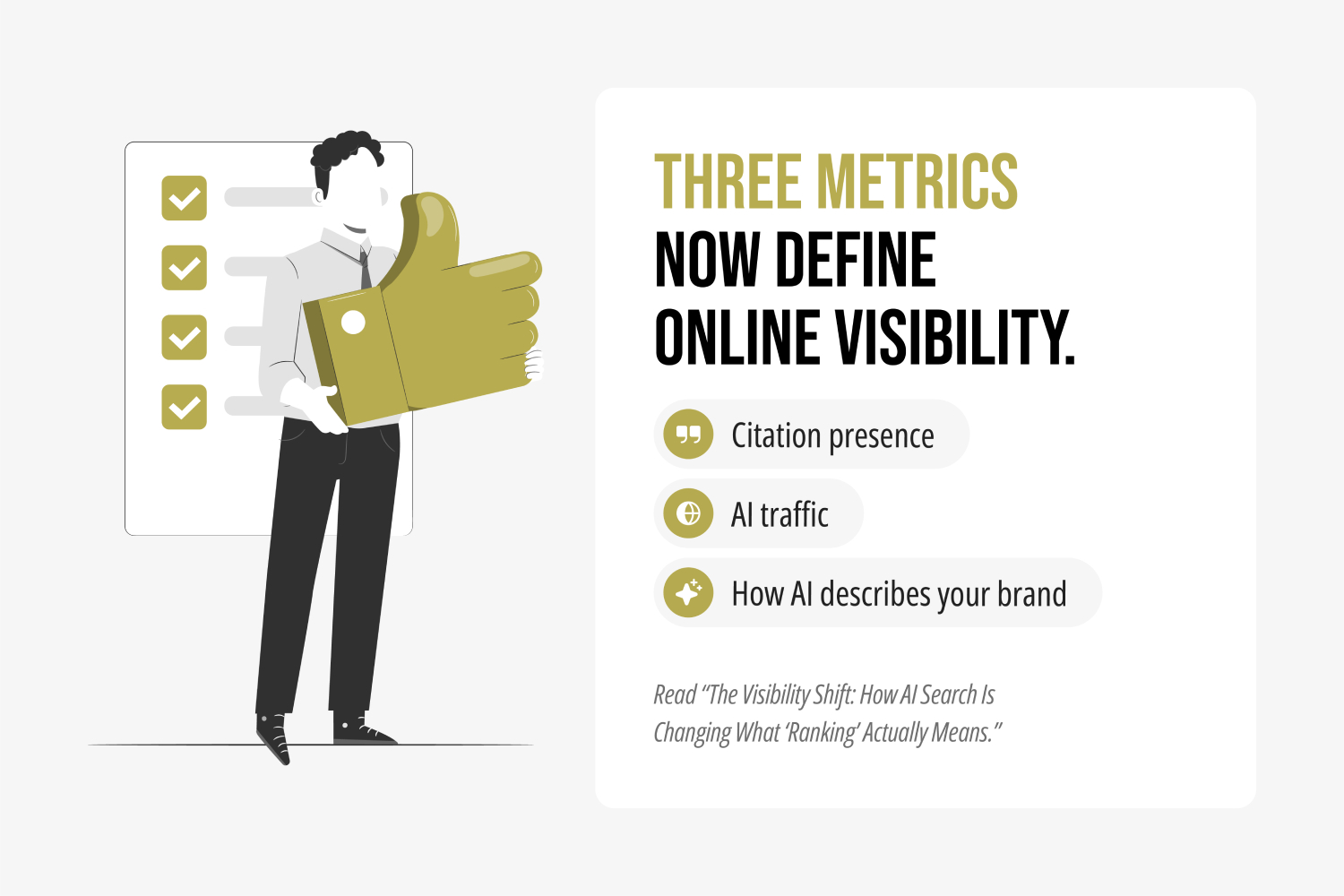
Here are the three, visibility-metrics that are missing from most mid-sized marketing dashboards right now:
1. AI Citation Presence and How to Actually Measure It
How often does your brand appear by name, by service, or by category inside AI-generated answers? This is your citation share, and it’s today’s equivalent of rank position.
You can approach this two ways: manually, or with a dedicated tool.
Manual testing (free, takes 30–60 minutes per month):
Open ChatGPT (with web search enabled), Perplexity, and Google AI Overviews. Run 15–20 high-intent queries that reflect how your ideal buyers actually search, not using keyword phrases, but using natural questions. For each, record:
- Is your brand cited?
- Mentioned by name?
- Recommended?
- What position in the answer?
- What do competitors appear instead?
What do those queries look like in practice? For example, a strategic marketing agency like Levo, the right prompts are the questions your buyers ask when they’re evaluating options about the category and problem you solve:
- ‘What are the best strategic marketing agencies for mid-sized businesses?’
- ‘Who are the top branding agencies in Tulsa or Oklahoma?’
- ‘What should I look for when hiring a marketing agency for a $10M company?’
- ‘What agencies specialize in mission-driven marketing?’
- ‘How do I know if my current marketing agency is the right strategic fit?’
- ‘What does a good brand strategy process look like for a growing company?’
If your brand’s name doesn’t appear in these answers, that’s the gap. It tells you exactly where your content, authority, and cross-platform presence need to improve.
Dedicated GEO monitoring tools (automated, ongoing):
A growing category of tools now automates this across multiple platforms simultaneously, tracking citation frequency, brand share of voice, competitor gaps, and sentiment over time without manual querying. Entry-level options start at around $29/month.
- Otterly.ai:
Tracks brand mentions and citations across six AI engines with automated weekly reports and Slack alerts.Named a Gartner Cool Vendor for AI in Marketing 2025. - Peec AI:
Tracks visibility, sentiment, and citation position across seven LLMs including ChatGPT, Perplexity, Gemini, and Grok. Includes competitive share-of-voice and GA4 integration. Backed by $29M in funding. - Semrush AI Toolkit:
If you already use Semrush for SEO, their AI visibility module layers GEO tracking into an existing workflow. Tracks AI Overviews, brand mentions, and citation sentiment. - HubSpot AI Search Grader:
A free tool that scans ChatGPT, Perplexity, and Gemini to evaluate your brand’s mention frequency, sentiment, and competitive positioning. A low-commitment starting point.
The honest caveat: no tool can show you every citation, because AI responses are non-deterministic which means they vary by query, context, and moment. What tools give you is directional signal, trending data, and competitive gaps. Combined with monthly manual spot-checks, that’s more than enough to build a meaningful GEO strategy.
2. AI Referral Traffic And How to Find It in GA4
AI chatbots and search engines are already sending traffic to your website right now. AI-referred sessions grew 527% year-over-year in early 2025 (Previsible) and Adobe reported a 693% surge over the same period. The problem is that GA4 was built before AI search existed — it buries this traffic inside ‘Referral’ or ‘Direct’ with no dedicated label. Most teams are flying blind on one of the fastest-growing traffic channels available.
The good news: you can fix this in about 15 minutes.
How to set up AI traffic tracking in GA4:
- Go to Admin → Data Display → Channel Groups → Create New Channel Group. Name it ‘AI Traffic.’ Add a new channel called ‘AI Search’ and set the condition to: Source matches regex — then paste this pattern: chatgpt.com|perplexity.ai|claude.ai|gemini.google.com|copilot.microsoft.com|deepseek.com
- Drag the AI Search channel above ‘Referral’ in the list — GA4 processes rules top-down, and if Referral catches it first, your AI traffic disappears. Save the group. GA4 applies this retroactively to historical data, so you’ll immediately see AI traffic that was always there but never labeled.
- Once set up, go to Reports → Acquisition → Traffic Acquisition, switch the channel group to your new ‘AI Traffic’ group, and add Landing Page as a secondary dimension. That last step is the most valuable: it shows you exactly which pages AI platforms are already citing and sending traffic to, which tells you what’s working and where to double down.
Important limitation to know:
What GA4 shows you is the visible floor of your AI traffic, not the ceiling. ChatGPT’s mobile app, Google AI Overviews, and most zero-click AI interactions don’t pass referrer data at all. They show up as ‘Direct’ or disappear entirely. Industry analysis suggests true AI influence on your traffic is 2–3x what GA4 reports. This is why citation monitoring tools (above) matter alongside traffic tracking. Some of your most valuable AI presence will never generate a click.
3. Citation Quality and Sentiment: What AI Is Actually Saying About You
Appearing in AI answers is only half the equation. What AI says about you when it does cite you is just as important and often more revealing. A recommendation is not the same as a neutral mention, which is not the same as being listed as an also-ran. These distinctions directly affect whether buyers move toward you or past you.
Citation quality breaks into four dimensions worth tracking:
- Recommendation vs. mention.
Is AI actively recommending your brand (‘Levo is a strong choice for mid-sized companies seeking strategic marketing’) or simply naming you in a list? Recommendations carry far more influence with the buyer reading the answer. - Positioning within the answer.
The first brand cited in an AI response shapes the answer’s framing. Being cited fifth carries less weight. Track where in the response your brand appears, not just whether it appears. - Accuracy.
Is what AI says about you factually correct? Does it describe your services, positioning, and strengths accurately v or is it pulling outdated, incomplete, or competitor-influenced information? Inaccurate AI citations are a brand risk that grows as AI search matures. - Sentiment.
Is the description positive, neutral, or qualified? ‘Levo brings strategic depth to mid-sized brand challenges’ reads very differently than ‘Levo is a Tulsa-based marketing agency.’
How to measure citation quality:
Start manually. When you run your monthly citation checks (described above), don’t just record whether your brand appeared. Score each appearance:
- Was it a recommendation or a mention?
- Was the description accurate?
- Was it positive?
Tools like Peec AI and Semrush’s AI Toolkit include sentiment scoring and positioning data across platforms, giving you a composite view over time without manual logging at scale.
The practical goal.
Move your brand from passive mention to active recommendation, from accurate citation to differentiated citation.
The content moves below are specifically designed to shift both because AI systems cite what they can summarize cleanly and authoritatively, and they recommend what they’ve seen validated across multiple trusted sources.
2x
the conversion rate of AI-referred visitors vs. traditional organic, in one-third the sessions. Source: Knotch data cited in the Conductor 2026 AEO/GEO Benchmarks Report
Three Strategic Moves for Mid-Sized Marketing Teams
GEO isn’t a replacement for SEO. It’s an additional layer built on top of it. Strong traditional SEO still matters. Research has consistently shown that a large share of AI Overview citations come from the organic top 10, meaning if you’re not ranking, you’re significantly less likely to be cited (Incremys, 2026). If your SEO fundamentals need strengthening, our SEO Checklist covers the ten core elements to get that foundation right. But here’s the shift that changes everything: ranking well is now the entry ticket, not the trophy. Getting cited by AI is a separate discipline and that’s where most brands currently have no strategy at all.
Here are three high-leverage moves your team can make now:
Move 1: Optimize for extractability, not just rankings
AI systems don’t rank pages. They extract answers. The content most likely to be cited is content that directly and clearly answers a specific question, within the first 200 words of the page, in structured, readable prose.
This means:
- Lead every blog post and service page with a direct, clear answer to the primary question.
- Use concise, quotable headers formatted as complete thoughts or questions.
- Include specific statistics, named frameworks, and expert-attributed insights. These are what AI systems lift and cite.
- Structure your FAQ sections to answer real buyer questions in 2–3 sentence responses that stand alone out of context.
- Implement FAQ schema, HowTo schema, and Article schema to signal to AI crawlers exactly what your content addresses.
Content depth and structural clarity now outweigh keyword density as citation signals. AI systems reward answers, not keyword clusters.
For a detailed technical walkthrough of how to structure your website for AI crawlers and citation systems, see Five Steps for Creating a Powerful AI-Optimized Website, the tactical companion to this article.
Move 2: Build entity authority beyond your website
Here’s the data point that most mid-sized businesses are not acting on: distributing content through earned media channels produces a median 239% lift in AI search visibility compared to brand-owned content alone, according to Stacker and Scrunch’s March 2026 study, the largest GEO study of its kind, analyzing 87 stories across 30 brands and 8 AI platforms. Third-party publisher sources accounted for 64% of all AI citations in the research.
AI systems evaluate brand entities, not just individual pages. They look at the consistency of your brand’s presence, the credibility of sources that reference you, and the breadth of your digital footprint. A brand that only publishes on its own domain is increasingly invisible to AI citation systems.
This means:
- Pursue earned media and guest content placements in trusted industry publications.
- Build and maintain a credible LinkedIn presence. LinkedIn is among the most-cited platforms by major LLMs.
- Create YouTube content on your core topic areas. YouTube citations appear frequently across AI responses.
- Encourage and manage customer reviews on platforms like Google, G2, and Capterra. Earned mentions from independent sources carry significant AI citation weight
- Ensure your brand’s Wikipedia presence, Google Knowledge Panel, and industry directory listings are accurate and complete.
Entity authority is the new domain authority. The question is no longer just ‘does your website rank?’ The question now is ‘does your brand exist credibly across the web?’
Move 3: Add author credentials and E-E-A-T signals to every piece
AI systems are increasingly weighting author credentials as a trust signal for citation decisions. Anonymous conten, or content with a generic ‘Marketing Team’ byline, carries less citation weight than content attributed to a named, credible expert with verifiable external presence.
Every content piece published on your website and LinkedIn should include:
- A named author with a genuine professional bio and linked profile.
- Specific experience claims (‘we’ve worked with 200+ mid-sized brands on rebranding initiatives’) rather than vague authority signals.
- External citations to reputable primary sources because AI systems trust content that trusts sources.
- A ‘Last Updated’ date because AI systems weight content freshness, particularly for fast-moving topics like digital marketing strategy.
What This Means for Your Marketing Investment
This is the conversation most marketing leaders need to have with their teams and leadership.
The shift from SEO to SEO + GEO is not a budget explosion. It’s a reallocation of where your content energy goes, and a recalibration of what you consider a win.
If you haven’t yet taken stock of how your website currently performs for AI visibility, not just search rankings, Your Website vs. AI: Winning Traffic Back walks through the specific technical and content audit steps your team can take today.
The business case is clear. AI-referred traffic converts at rates that dwarf traditional organic. Brands building citation authority now are creating a compounding advantage that becomes harder to displace as AI search matures further. The brands that delay this shift aren’t just missing opportunity, they’re ceding positioning in a channel that, by 2028, is expected to account for half of all search activity.
For mid-sized businesses specifically, this is actually a competitive opportunity. GEO rewards content intelligence and brand clarity over budget scale. A well-positioned, clearly articulated mid-sized brand with genuine expertise and a coherent cross-platform presence can outperform a larger competitor whose content is bloated, generic, or poorly structured.
Mission-driven organizations are especially well-positioned here. AI citation systems reward clarity of purpose, specificity of expertise, and authenticity of voice. Brands that can clearly articulate who they serve, what they stand for, and why they’re different (in language that’s direct and evidence-backed) are precisely the brands AI systems cite with confidence.
The window is open, but it won’t stay open.
According to BrightEdge’s 2025 State of Search report, only 12% of businesses have completed a formal GEO audit and only 34% have trained their teams in GEO (Incremys, 2026). That gap is your first-mover advantage. Brands that build citation authority now will be substantially harder to displace as AI search continues to mature.
Frequently Asked Questions
Is traditional SEO dead now that AI search is here?
No, and anyone telling you otherwise is oversimplifying. SEO is now necessary but no longer sufficient on its own. Strong SEO still matters: historically, most AI Overview citations came from the organic top 10 but that overlap has been declining. ALM Corp’s 2026 analysis found the figure dropped from 76% in mid-2025 to roughly 38% by early 2026, meaning AI systems are increasingly citing pages that don’t hold top traditional rankings. The implication: you should rank well AND optimize for AI citation separately. But ranking alone no longer guarantees the visibility, traffic, or brand presence it once did. The winning strategy today is a hybrid SEO + GEO approach, where traditional ranking forms the foundation and GEO optimization builds the citation layer on top.
How do I know if my brand is being cited in AI search results?
Start with manual testing. Open ChatGPT, Perplexity, and Google AI Overviews and search for 10–15 queries your ideal buyers would actually ask — questions about your services, your competitors, your category, and specific problems you solve. Note whether your brand appears, what it says, and in what context. Tools like Semrush’s AIO, Peec.ai, and SE Ranking now offer AI visibility tracking dashboards. Also set up Google Analytics 4 to segment traffic by AI referral sources so you can see what’s already arriving from these platforms.
Does GEO require a completely new content strategy?
Not from scratch, but it does require meaningful upgrades to how your content is structured, attributed, and distributed. The core shift is from writing content primarily to rank to writing content primarily to answer. That means leading with direct answers, adding specific data and named expertise, distributing beyond your own website, and ensuring every piece is attributed to a credible author. For most mid-sized teams, this is an evolution of existing content, not a rebuild.
How long does it take to see results from GEO optimization?
Faster than many expect, particularly for content freshness signals. AI systems weight recency heavily for fast-moving topics. A well-structured, recently published or updated article can appear in AI citations within weeks. Building broader entity authority through earned media, LinkedIn presence, and cross-platform distribution is a longer-term investment, typically showing compounding returns over three to six months. The key is to start now rather than waiting for a perfect strategy.
Is GEO realistic for a mid-sized business without a large marketing team?
Yes and it may actually favor you. GEO rewards content intelligence and brand clarity over budget scale. A mid-sized business with genuine expertise, a clear point of view, and well-structured content can outperform a larger competitor whose content is generic and bloated. The most effective GEO investments are optimizing content structure, adding author credentials, building LinkedIn presence, and pursuing strategic earned media are effort-intensive but not necessarily expensive. The biggest barrier for most mid-sized teams isn’t budget. It’s knowing what to prioritize.
What to Do Next
The search landscape has changed. And the definition of ‘ranking well’ has changed with it. The brands winning visibility aren’t necessarily the ones with the biggest budgets or the longest SEO track record. They’re the ones who understood the shift early and adjusted what they measure, how they create content, and how they build their brand presence across the web.
The gap between traditional SEO performance and actual AI visibility is where your opportunity lives right now. And that gap is measurable, closeable, and for brands that move early, a genuine competitive advantage.
Ready to audit your AI search visibility?
At Levo, we help mid-sized businesses and mission-driven organizations close the gap between where they rank and where they’re actually visible across both traditional and AI-driven search. If you’re not sure where your brand stands in the new search landscape, let’s find out together.
Book your free 30-minute consult. No pitch. No pressure. Just clarity.
Sources
- Incremys / Semrush (2025–2026). 60% zero-click rate; 2.6% CTR at #1 with AI Overview present. https://www.incremys.com/en/resources/blog/geo-statistics
- Conductor AEO/GEO Benchmarks Report (January 2026). AI Overviews in 25.11% of searches; 1.08% AI referral traffic share across 10 industries. https://www.conductor.com/academy/aeo-geo-benchmarks-report/
- OpenAI (October 2025). ChatGPT surpassed 800 million weekly active users. https://openai.com
- Knotch data via Conductor (2026). AI visitors convert at 2x the rate of organic in one-third the sessions. https://www.conductor.com/academy/ai-referral-traffic/
- Semrush (2026). AI-driven visitors convert at 4.4x the rate of organic across industries. https://www.semrush.com
- Previsible 2025 AI Traffic Report. AI-referred sessions grew 527% year-over-year. https://www.previsible.io
- Adobe Digital Trends (2025). AI referral traffic to retail sites grew 693%. https://www.adobe.com/experience-cloud/digital-insights.html
- BrightEdge State of Search (2025). Only 12% of businesses have completed a formal GEO audit. https://www.brightedge.com
- Incremys (2026). Only 34% of companies have trained their teams in GEO. https://www.incremys.com/en/resources/blog/geo-statistics
- Stacker & Scrunch (March 2026). Earned media distribution produces a median 239% lift in AI visibility; 87 stories, 30 brands, 8 platforms. https://stacker.com/blog/latest-research-on-expanding-brand-visibility-across-llms
- ALM Corp (February 2026). AI Overview citation overlap with organic top 10 dropped from 76% to ~38% between mid-2025 and early 2026. https://almcorp.com/blog/google-ai-overviews-surge-9-industries/
- Ahrefs (February 2026). AI Overviews reduce position-one organic CTR by 58%. https://ahrefs.com
- Gartner (2024 forecast). Traditional organic search traffic projected to decline 50% by 2028. https://www.gartner.com
Levo | Grounded in Truth. Proven in Market.
Marketing works best when it’s human, honest, and connected.
How effective is your digital marketing, really?
Take our quick free audit to discover if your digital marketing, SEO and GEO are underperforming, and what to do next.
Take Free Audit
