

- All
- Advertising + Marketing
- Branding
- Case Studies
- Environmental Design + Tradeshows
- Mission-Driven Marketing
- SEO, GEO + Digital Marketing
- Web Design + Development
How strong is your
brand, really?
Take our short free audit to find out where your brand stands—and how to turn
strategy into impact. (It only takes 2 minutes—and can unlock the clarity your
brand needs to thrive.)
Posted by Anya Sleezer
Last Updated on: October 19, 2026
At a glance
This guide is for marketing leaders, founders and executives at midsized companies who want their brand to show up when buyers ask Google AI Overviews or ChatGPT for a recommendation. You will learn how these AI tools choose which brands to mention, why most AI SEO checklists miss the real issue, a five-minute test to see how AI describes you today, and a four-part framework for becoming the brand AI can describe and recommend with confidence. Why does this matter? Because buyers now build their short list inside AI answers before they ever visit your website.
Table of contents
- The short answer
- Why the AI visibility playbook misses the point
- How AI Overviews and ChatGPT decide which brands to mention
- The Describability Test: Can AI explain your brand?
- The four signals of a describable brand
- What AI says about you and what to investigate
- If you remember only three things, make them these
- Frequently asked questions
- Sources
When a buyer asks ChatGPT to recommend a company like yours, what would it say about you? Your website is only part of the answer. AI may also draw on case studies, reviews and other sources. If they tell different stories, AI may get your brand wrong or leave you out.
Marketing leaders ask me how to show up in AI Overviews and ChatGPT. I start with the brand: Is it clear who you serve, what you’re known for and why a buyer should choose you?
Many blogs answer with a long technical checklist. Technical SEO matters, but it can’t answer that question for you. This blog starts with your brand.
The short answer
To show up in Google AI Overviews and ChatGPT, your pages need to be crawlable and indexed, and your brand needs to be easy to describe and easy to verify. AI tools build answers from many sources, and most of them aren’t your website. The brands that get mentioned clearly say who they serve and what they do, prove it with specifics, and have credible third parties saying the same thing.
Technical SEO gets you into the room. A clear, consistent brand gets you named.
Why the AI visibility playbook misses the point
McKinsey found that about half of U.S. consumers surveyed use AI-powered search. If a buyer asks AI to recommend a company like yours, you want to be in the answer. But first, AI needs to understand what makes your company worth recommending.
There’s plenty of advice on how to show up: add schema, create an llms.txt file, break your content into tiny chunks. I can see why a checklist appeals to busy marketing teams. But it can pull your attention away from a more useful question like, “Is it clear what your company does, who it helps and why someone should choose it?”
Google says its AI features still rely on core Search systems. It recommends useful, original content written for people, and says you don’t need machine-readable files, special schema markup, or content broken into tiny pieces to appear. OpenAI says any public website can appear in ChatGPT search and advises publishers to allow its search crawler to access their content. Neither platform describes a way to buy or hack your way into a better placement.
I’ve covered the search basics in earlier articles on what ranking means in AI search and how to win website traffic back from AI. They matter. But they’re only the starting point.
Crawlability gets you considered. It doesn’t make you compelling.
If you want to know whether AI can recommend your company, I’d ask:
- Can AI find and read information about your company?
- Can it tell who you serve, what you do and why a buyer should choose you?
- Do your case studies, reviews and other sources back up that story?
That first question is about search fundamentals. The other two are about your brand. Google’s guidance calls for “a unique point of view” and cautions against repeating what’s already online. To me, that sounds like good marketing: say something useful, make it easy to understand and show people why they should trust you.
I’ve helped companies figure out what they stand for and how to say it since 2006. AI hasn’t changed the need for that work. It has made the gaps easier to see.
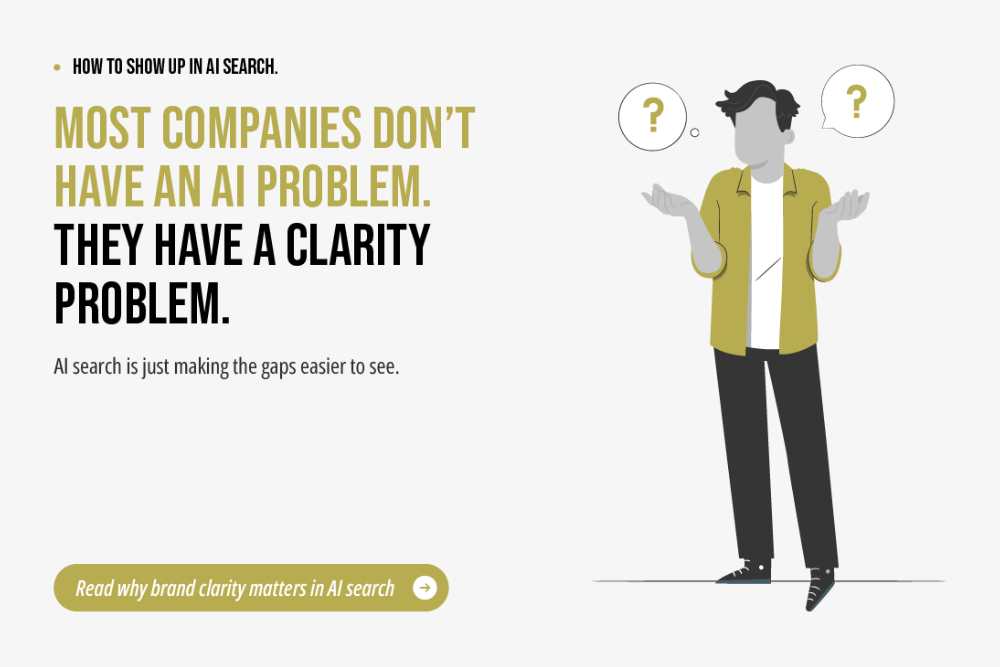
AI search didn’t create the gap. It just made it easier to see.
How AI Overviews and ChatGPT decide which brands to mention
Here’s how the process works. When someone asks a question, Google’s AI features use what Google calls query fan out. The system runs several related searches on the subtopics behind the question, then pulls the answers together and links to supporting pages. To be one of those links, a page must be indexed and eligible to show a snippet in regular Google Search. ChatGPT search works in a similar way. It searches the web, reads what it finds and cites its sources.
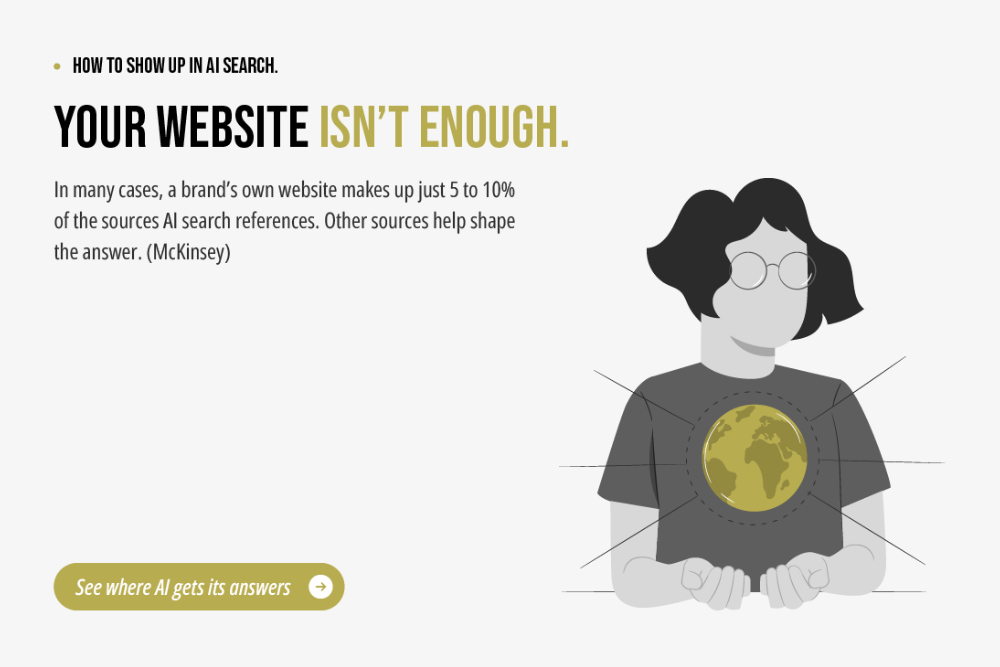
Your website is only part of the story AI tells about you.
A checklist that stops at your website misses where AI gets the rest of its information about your brand. I looked into those sources, and three findings stood out.
- Your site is a small part of the picture.
McKinsey found that a brand’s own website typically makes up only 5 to 10 percent of the sources AI search references! Read that again. Publishers, reviews, user communities and affiliate sites make up most of the rest. - Mentions beat links.
In a study of 75,000 brands, Ahrefs found that branded web mentions had the strongest correlation with AI Overview visibility (0.664), roughly three times stronger than the number of backlinks (0.218). What does this mean? The top three factors were all off site. - Few people click.
In a Pew Research Center study, users clicked a link inside a Google AI summary in just 1% of visits where an AI summary appeared. A buyer may read the answer without visiting your site, so what it says about your company matters.
By The Numbers
- 5 to 10%.
The share of AI search sources that are a brand’s own website. (McKinsey) - ~3x.
How much more strongly branded web mentions correlated with AI Overview visibility than backlinks did. (Ahrefs)
AI draws on information from across the web. Google’s AI features still rely on its core search systems, so SEO matters. But your website is only one source. When your case studies, reviews and profiles tell the same clear story, AI has a better chance of describing your company accurately. When they conflict, it may get you wrong or leave you out altogether.
The Describability Test: Can AI explain your brand?
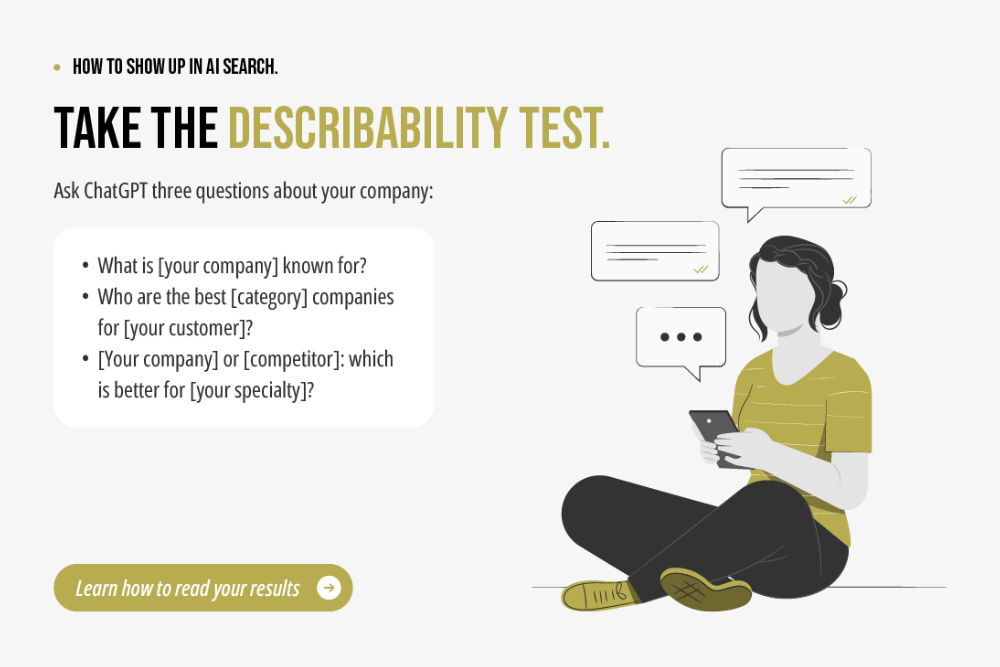
Three questions, five minutes, and a clear look at how AI sees your brand.
Before you spend another dollar on tools or tactics, find out what AI says about you. It takes about five minutes. Open ChatGPT and Google’s AI Mode and try these three prompts, filling in your own details:
- “What is [your company] known for?”
This shows whether AI has a clear, accurate picture of your brand. - “Who are the best [your category] companies for [your ideal customer]?”
This shows whether you make the short list when a buyer does not know your name yet. - “[Your company] or [your top competitor]: which is better for [a use case you want to own]?”
This shows whether AI understands what makes you the right choice.
One tip: these tools can give different answers on different days. Run each prompt a couple of times and look for patterns.
Read the answers like a buyer. You will usually see one of four results:
- Accurate and specific.
AI names your audience, your strengths and your proof. Your brand is describable. Keep building. - Vague or generic.
AI calls you something generic like “a company offering innovative solutions.” That is a clarity problem. - Wrong or outdated.
AI lists old services, the wrong market or a former positioning. That is a consistency problem. - Missing.
You do not appear at all. That is usually a proof and third-party visibility problem.
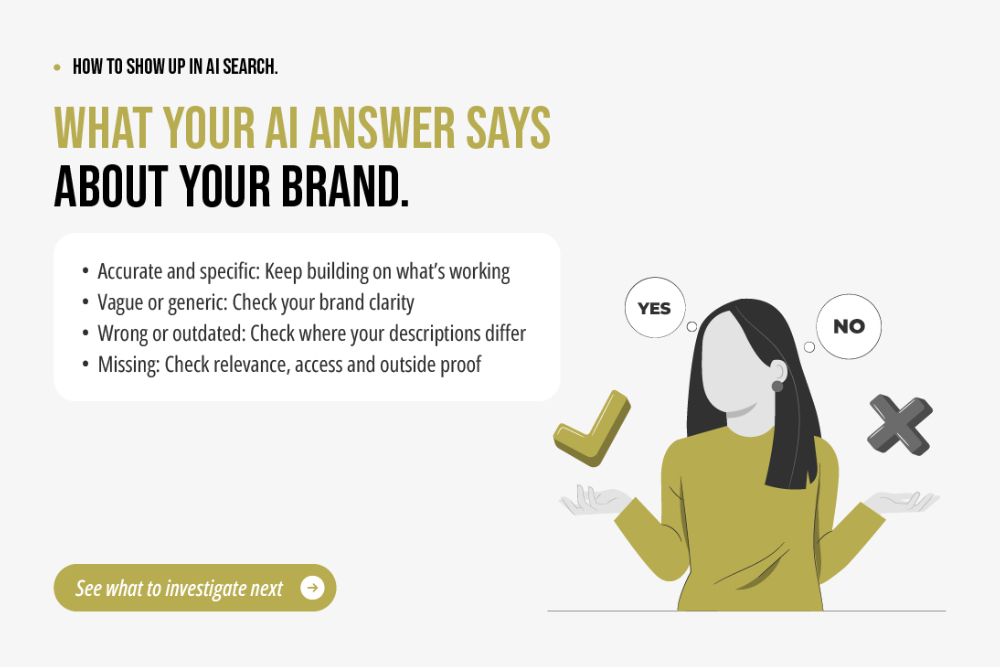
Your results tell you exactly where to look next.
The vague answer is the one that stings. If ChatGPT calls you “a leading provider of innovative solutions,” it isn’t exactly wrong. It could just as easily be describing half your competitors. And in fairness to AI, if that’s the language we gave it, that’s the language it will repeat.
Many midsized companies land in the vague category because their websites and profiles lean on phrases like “customer focused,” “full-service partner” and “quality solutions.” When every competitor makes the same claims, your messaging gives AI little reason to single you out. If that sounds familiar, read my article on why distinctiveness wins for a better way to make your brand recognizable and memorable. The search consequence is simple: generic language makes you invisible to AI, not just forgettable to people.
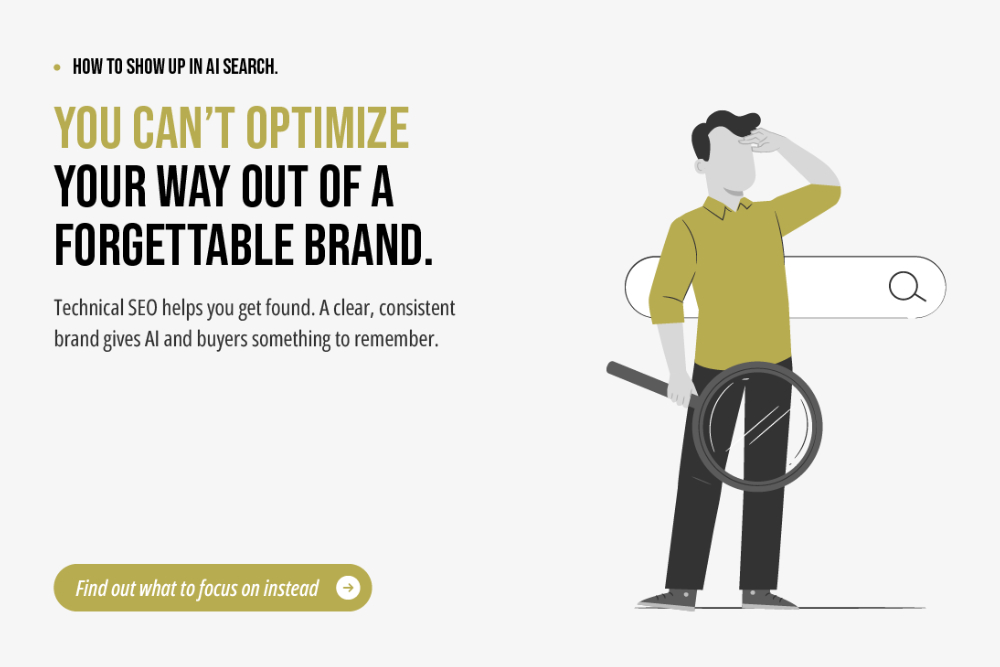
Getting found is step one. Being memorable is what gets you recommended.
The four signals of a describable brand
So, if AI repeats what the market says about you, the goal is simple. Give the market something clear, true, memorable and consistent to say. At Levo, we look at four signals that build on each other:
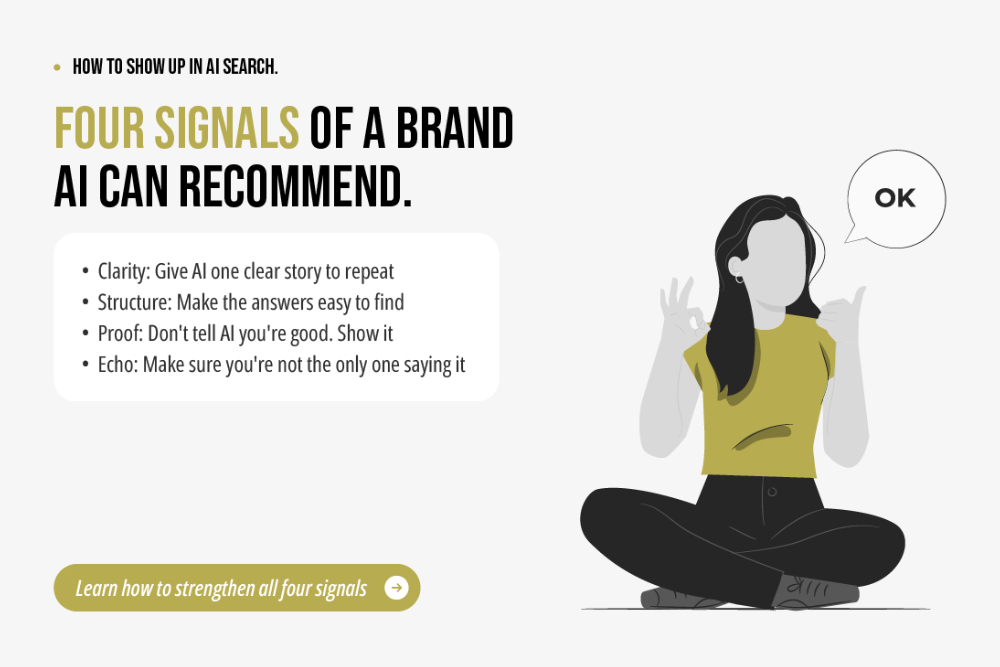
Clarity, Structure, Proof and Echo. Each one builds on the one before it.
1. Clarity: Give AI one clear story to repeat.
Say one thing, the same way, everywhere. Start with one memorable and unique description of your brand. Who do you serve? What problem do you solve? Why are you the right choice? Then use those same words on your homepage, LinkedIn page, leadership bios, directory listings, sales decks and press boilerplate. When your descriptions don’t match, AI hedges or picks the wrong one. When they match, AI can repeat them with confidence.
Start with your brand strategy. AI can’t explain what your company stands for if your own team isn’t sure. That’s the work behind our RallyPoint process: uncovering your core belief and building a message your team can use consistently. If your message feels scattered, read more about why brand stories lose their way and where to begin.
If your own team can’t clearly explain who you serve and why buyers choose you, AI won’t solve that for you.
2. Structure: Make the answers easy to find.
Build a website that answers real buyer questions. Remember query fan out? AI breaks a question into the smaller questions behind it, then goes looking for pages that answer them. Who is this for? What does it cost? How long does it take? How does it compare? What results has it delivered? A site that answers those questions plainly, with a clear page for each service and each audience you serve, gives AI something worth citing. Our website planning guide for midsized companies walks through how to map that out.
If buyers have to hunt for answers, AI will too.
Clear writing for real people is what works. The structure that helps a busy customer find an answer fast is the same structure that helps AI find it. Our web design and development team builds sites around buyer questions from the start, and our 90 day plan for after your website launch shows how to keep improving them.
3. Proof: Don’t tell AI you’re good. Show it.
Replace claims with specifics. AI and buyers have something in common: they both trust facts they can check. “Trusted partner” is a claim. A named client, a real result, a certification or a published case study is proof. The more specific your evidence, the easier it is for AI to match you to a very specific question.
Claims tell buyers what you want them to believe. Proof lets them see for themselves.
Case studies do this job best when they tell the whole story: the challenge, the insight and the outcome. A good case study isn’t a victory lap. It’s a clear record of what needed to change and what happened. Here’s how we did that for MorseLife’s employer brand and for Red Maple’s B2B software growth. You’ll find more case study examples on our work page.
4. Echo: Make sure you’re not the only one saying it.
Get credible sources to say it too. Since most AI sources aren’t your website, you need other people telling your story. Think industry publications, podcasts, review sites, business directories, partner pages, association listings, conference programs, LinkedIn and YouTube. Brand mentions and reviews are among the strongest factors. What others say about you carries more weight than what you say about yourself.
Echo only works after clarity. If you amplify a muddled message, you just spread the confusion faster.
Make sure to keep it real. Echo is earned, not bought. One relevant mention from a respected source beats a pile of directory spam. This is also why the old obsession with backlinks deserves a second look. Links still help, and our guide to boosting domain authority explains why. But in AI answers, mentions carry more weight.
Don’t overlook events, either. A speaking session, an exhibitor listing or trade press coverage from a show all create third-party mentions tied to your category. That’s echo you’re probably already paying for, so make it count. Our guide to planning a standout trade show booth is a good place to start.
SEO gets you ranked. GEO gets you cited. A clear brand gets you recommended.
What AI says about you and what to investigate
Here’s a quick cheat sheet for reading your Describability Test results. AI search isn’t an exact science, so treat this as a place to start, not a final diagnosis.
| What you see in AI answers | What to investigate | Where to start |
| You’re missing from category answers | Whether your pages fit the question and can be indexed, and whether credible sources mention you in that category | Structure: Check search basics first, then build proof and third-party visibility |
| You’re described in vague, generic terms | The positioning language on your site and public profiles | Clarity: a specific, buyer-facing description built on your RallyPoint |
| You’re described incorrectly or with old information | Outdated pages, listings, bios and outside references | Clarity: update what you control and request corrections elsewhere |
| A competitor is recommended for your specialty | Differences in relevance, specificity and proof | Proof: case studies, results, credentials |
| You’re mentioned, but your website is never cited | Whether your pages answer the question directly and meet crawl and index rules | Structure: page content, navigation, crawler access |
Three things I want you to remember
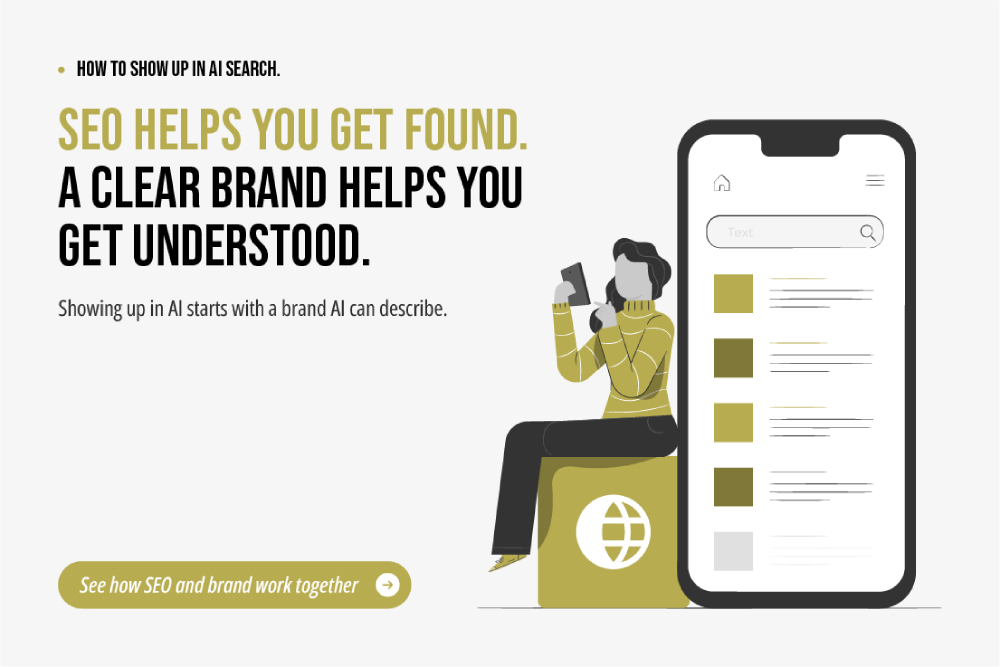
SEO and brand work best when they work together.
1. Bring your brand, content and SEO teams together to work on AI visibility.
SEO matters, and it’s a big part of how we work. But AI visibility crosses brand, PR, web, content, social, sales and even events. You have to connect the dots. It’s the same reason I care so much about closing the marketing alignment gap.
2. Don’t buy another AI visibility tool until you know what you want AI to say about you.
Measurement is useful. Measuring a muddled brand more precisely isn’t. Clarity first. Then measure.
3. Start measuring now, even if it isn’t perfect.
Google now offers a Generative AI performance report in Search Console, so you can see how your pages show up in its AI features. ChatGPT adds utm_source=chatgpt.com to its referral links, so you can spot those visits in GA4. Run the Describability Test every quarter, save the answers and watch for patterns. Our guide to finding the hidden marketing leaks that cost you customers can help you connect it all to real leads.
And if you’re a midsized company, here’s your edge. You have fewer layers between a decision and a consistent message than a big enterprise with many divisions and many voices. Use it. The brands that get suggested are the ones that are easy to understand.
FAQs
How do I rank in Google AI Overviews?
There’s no guaranteed spot in a Google AI Overview. Start by making sure Google can crawl and index your pages and show them with a snippet. Then focus on useful, original content that answers your buyers’ questions and is easy to navigate. Keep your company information accurate across other credible sources, too. Use the Generative AI performance report in Search Console to see how your content performs in Google’s AI features.
How do I get my business to show up in ChatGPT?
First, check that OAI-SearchBot can access your site. Your robots.txt file, hosting provider or content delivery network can block it. Then make it easy to understand what your company does, who it helps and why buyers choose it. Clear website pages, current profiles, reviews and credible third-party mentions all contribute to that picture. There’s no guaranteed way to get recommended.
Do I need schema markup or an llms.txt file to appear in AI answers?
Google says you need neither for AI Overviews. Schema can still help your pages qualify for other search features, but there’s no special markup or AI text file that earns you a place in an AI answer. Focus first on useful content, a site Google can access and accurate information about your company.
Why does ChatGPT describe my company incorrectly or leave it out?
There isn’t always one reason. Your pages might be inaccessible or a poor match for the question. ChatGPT might also find outdated descriptions or conflicting information elsewhere. Ask it questions a buyer would ask, repeat the test and check the sources ChatGPT cites when it provides them. Then correct what’s outdated and make sure your current message is clear across your site and profiles.
How long does it take to improve AI search visibility?
It depends on what needs fixing. You can update your site quickly, but search tools need time to find those changes. Building stronger case studies, reviews and credible mentions takes longer. Start with what you control, then check how your company appears for relevant buyer questions over time. I wouldn’t promise a set date for appearing in AI answers.
Not sure what AI is saying about you? Let’s find out together.
Become the brand AI can describe
Ask ChatGPT what your company is known for. Does the answer reflect what you want buyers to understand? If not, let’s find out what’s getting lost. At Levo, we help midsized companies and mission-driven organizations become clear, consistent and credible everywhere buyers and AI look. Book a free 30-minute consult and we’ll run the Describability Test together and show you where to start. Rather start on your own? Take our free two-minute marketing audit.
Sources
- Google Search Central, “Google’s Guide to Optimizing for Generative AI Features on Google Search” (updated July 2026)
- Google Search Central Blog, “Introducing Search Generative AI performance reports in Search Console” (June 2026)
- Google Search Central, “AI Features and Your Website”
- OpenAI Help Center, “Publishers and Developers FAQ”
- McKinsey and Company, “New front door to the internet: Winning in the age of AI search” (October 2025)
- Ahrefs, “An Analysis of AI Overview Brand Visibility Factors (75K Brands Studied)”
- Pew Research Center, “Google users are less likely to click on links when an AI summary appears in the results” (July 2025)
- HubSpot, “How to Show Up in ChatGPT Results and Get Noticed by Customers” (July 2026)
- Neil Patel, “SEO for ChatGPT: How to Rank Your Website in the LLM” (2026)
- Forbes Communications Council, “What Is AI Doing to Your Brand’s Primacy on the Web and What Can You Do About It?” (July 2026)
- American Marketing Association, “From Search to Suggestion: Positioning Your Brand for AI-Powered Discovery”
How strong is your
brand, really?
Take our short free audit to find out where your brand stands—and how to turn
strategy into impact. (It only takes 2 minutes—and can unlock the clarity your
brand needs to thrive.)
