


- All
- Advertising + Marketing
- Branding
- Case Studies
- Environmental Design + Tradeshows
- Mission-Driven Marketing
- SEO, GEO + Digital Marketing
- Web Design + Development
Is your website
holding you back?
Take our quick audit to discover what’s working—and what’s not. In just 5 minutes, we’ll help you assess your site’s performance, identify gaps, and get a tailored action plan to move forward.
Take Free Audit
Posted by Anya Sleezer
Last Updated on: June 9, 2026
At a Glance
Most teams treat a website launch as the finish line. In reality, it’s the starting point—and where many websites begin to lose momentum. Let’s break down why websites underperform immediately after launch, the gap between launch and performance, and what high-performing marketing teams actually do in the first 90 days to drive visibility, engagement, and conversion.
Table of Contents
The Myth: Launch = Success
There’s a persistent belief, especially among mid-sized companies that once a website launches, the hard part is done. It’s true, the redesign is complete, the UX is improved, messaging is updated, and budget has been invested. But that doesn’t mean performance will follow.
Performance comes from what happens after the launch. That’s where most organizations fall short.
Why Websites Start Falling Behind Immediately After Launch
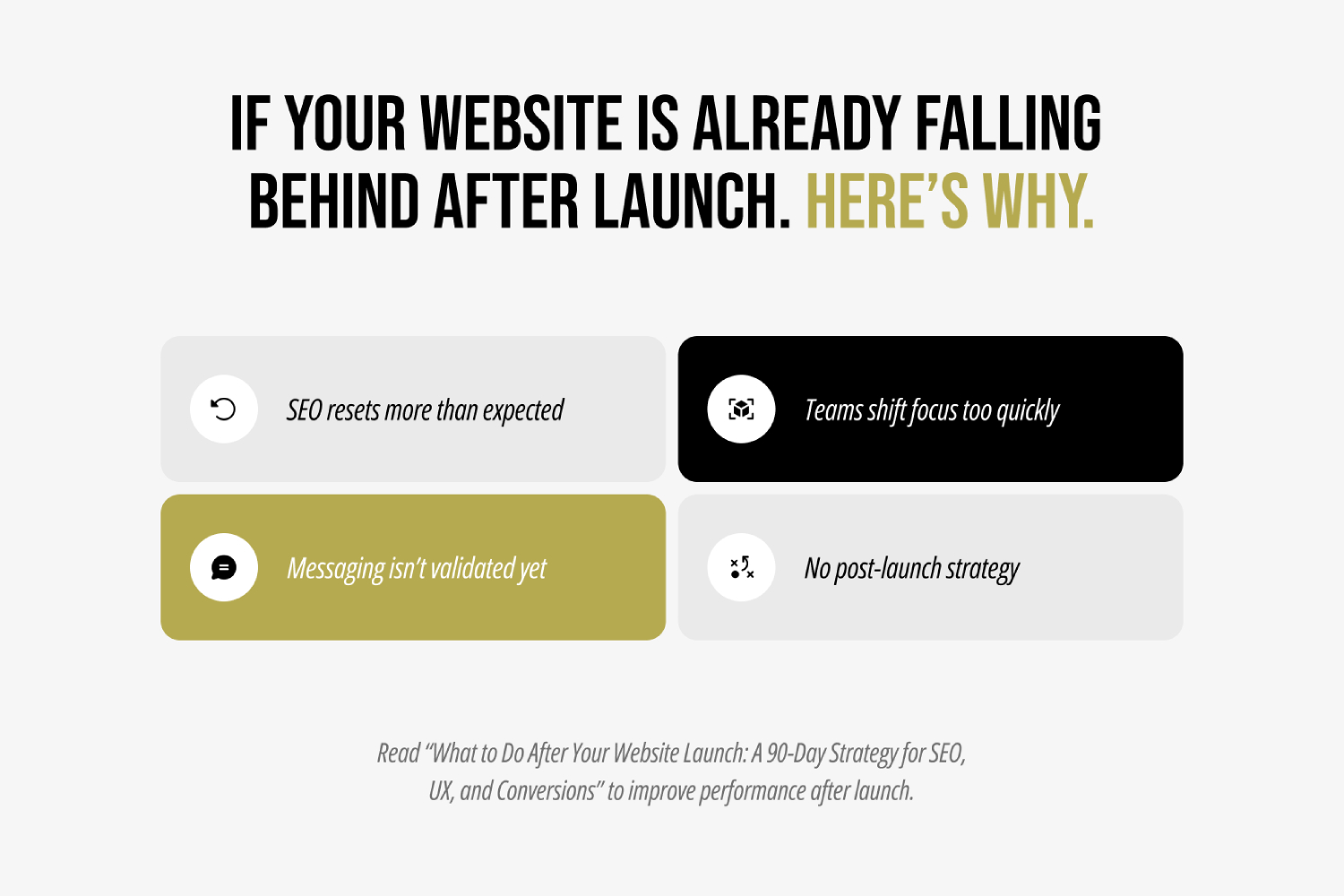
The moment your site launches is often when performance risk is highest.
- SEO resets more than expected.
Even well-executed migrations can disrupt rankings, indexed pages, and internal linking structures. - Messaging hasn’t been validated yet.
Your positioning may be strategically sound, but until real users interact with it, gaps appear. - Teams shift focus too quickly.
After launch, internal energy moves on to other priorities. - Most organizations lack a structured post-launch plan.
They have detailed launch checklists, but no equivalent roadmap for optimization, testing, or performance tracking.
The Real Gap: Launch vs. Performance
Launching a website is an execution milestone. Performance is a system.
That system includes SEO visibility, user behavior, content relevance, conversion pathways, and continuous iteration. The gap between launch and performance is where most websites fail—not because they were poorly built, but because they weren’t strategically managed after launch.
What High-Performing Teams Do Differently
The difference isn’t budget. It’s mindset and process. High-performing teams treat launch as Version 1, not the final product. They:
- Build a 90-day optimization roadmap before launch
- Track behavior obsessively, not just traffic
- Prioritize continuous improvement over large redesign cycles
- They also align SEO, UX, messaging, and conversion as one system.
This is where many organizations struggle, especially when website strategy, content, and performance are handled in silos. For example, teams that actively evolve their content strategy post-launch—rather than relying on static pages—see stronger results, as outlined in this guide to creating high-value, search-friendly content.
The key insight is simple: the first 90 days determine whether your website becomes a growth engine—or a static asset.
The First 90 Days: A Strategic Framework
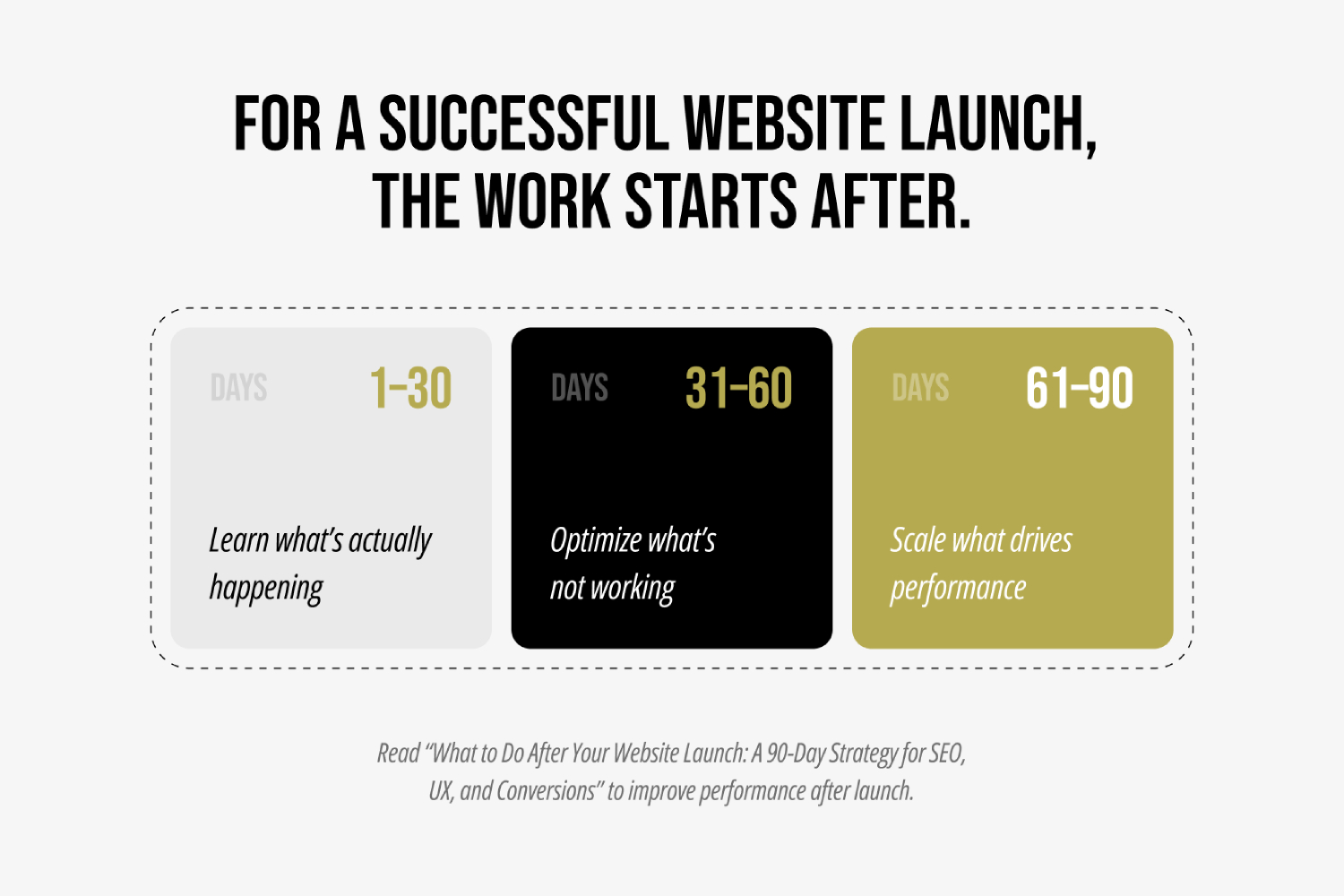
Follow this performance model to move beyond launch and turn your website into a measurable, continuously improving growth engine.
Days 1–30: Stabilize + Learn
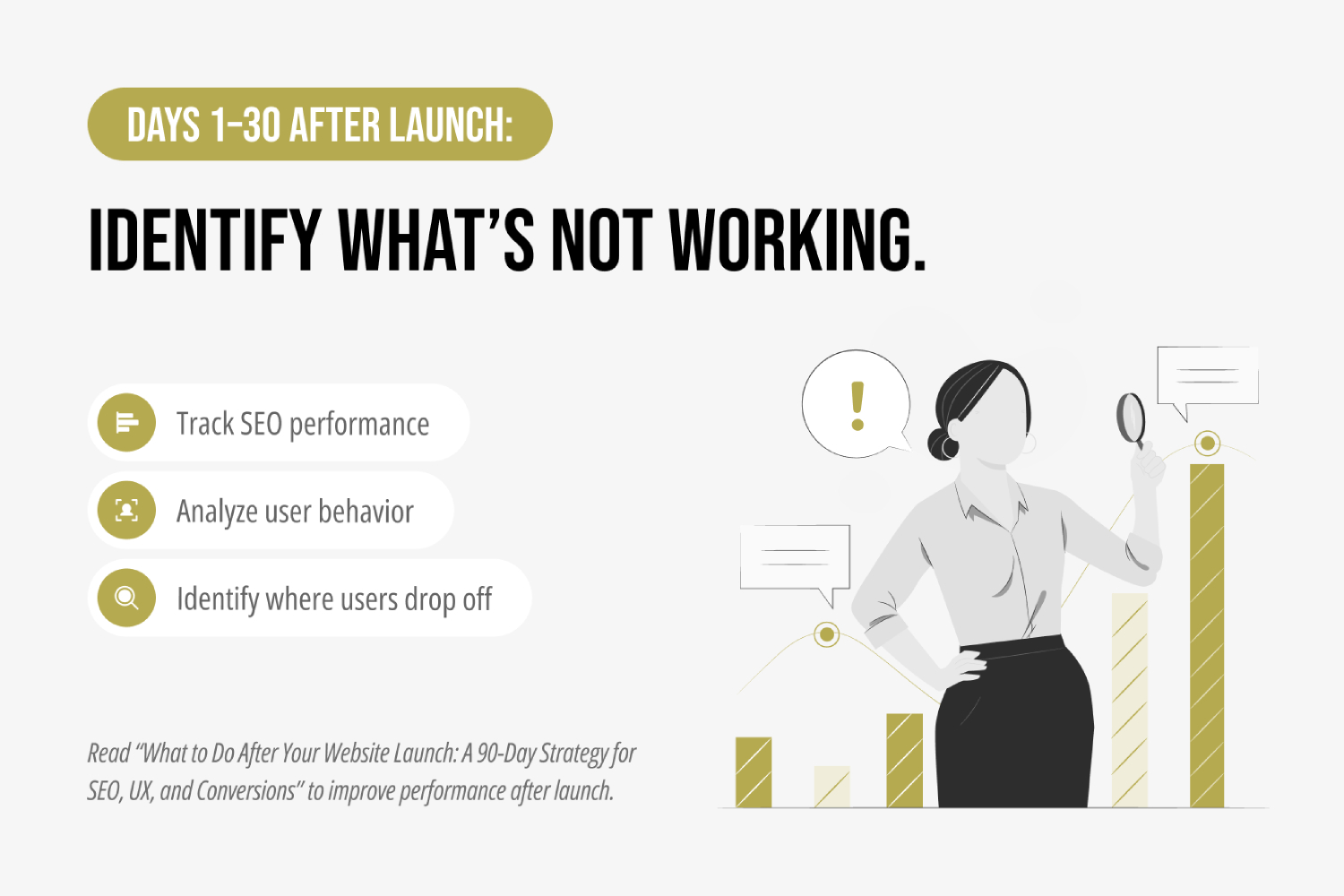
The goal is to understand what’s actually happening. This includes monitoring indexing and crawl issues, validating redirects, and tracking ranking fluctuations. On the UX side, teams should review heatmaps and session recordings to identify friction points and analyze engagement patterns.
Messaging should be evaluated based on real user interaction—where users drop off, what they engage with, and whether the value proposition is clear. Conversion baselines should also be established, including CTA performance and form completion rates.
At this stage, the priority isn’t fixing everything immediately—it’s identifying where the gaps are.
Days 31–60: Optimize + Expand
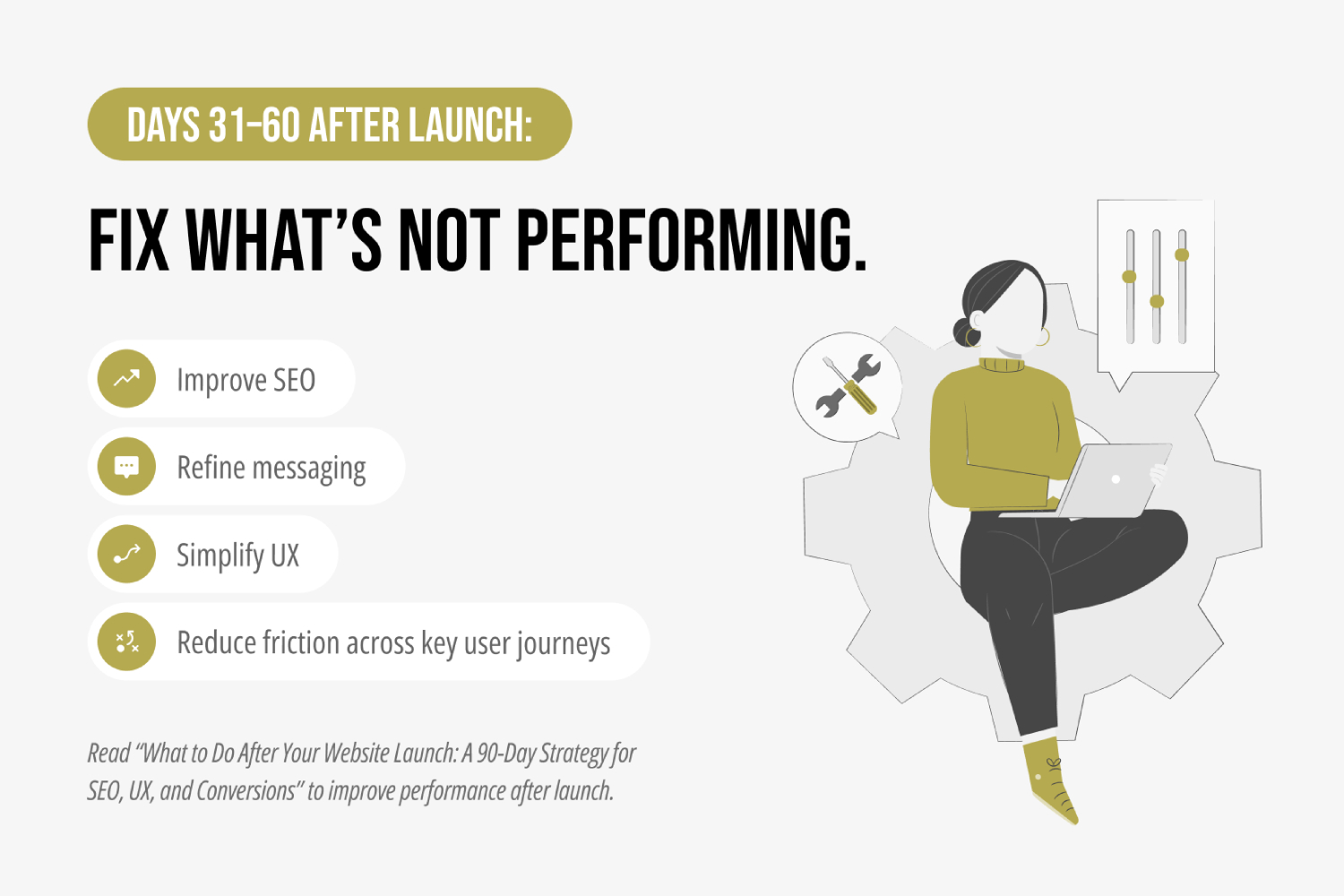
With data in place, teams can begin making targeted improvements. SEO efforts should focus on optimizing underperforming pages, strengthening internal linking, and expanding content around missed keyword opportunities.
UX improvements might include refining navigation, simplifying layouts, and reducing friction in key user flows. Messaging should be adjusted to improve clarity and alignment with user intent.
This is also where conversion improvements begin to take shape. Testing CTA variations, simplifying forms, and improving landing page structure can drive meaningful gains.
Even small changes—like improving visual hierarchy or clarity—can have a measurable impact, especially when aligned with modern usability expectations such as those outlined in current website design trends.
Days 61–90: Scale + Convert
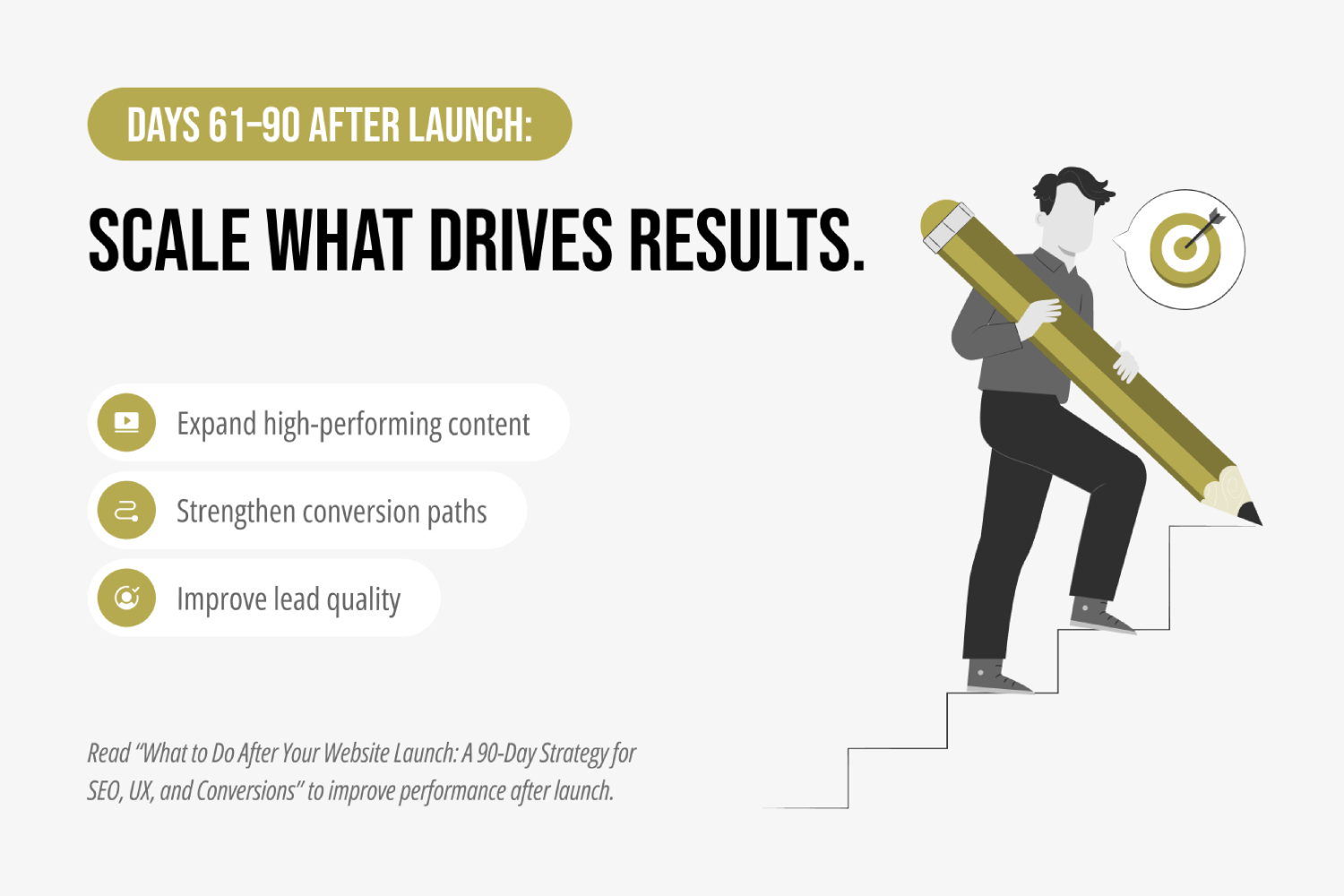
By this stage, patterns begin to emerge. Teams can scale what’s working by expanding content tied to performance data, improving pathways to conversion, and refining user journeys.
SEO efforts should focus on building authority around key topics, while UX improvements should enhance efficiency and clarity across devices—especially mobile.
Messaging should double down on what resonates and eliminate what doesn’t. Conversion optimization should evolve into more advanced testing and funnel improvements, with a focus on lead quality rather than just volume.
At this point, the website begins to function as a reliable growth channel rather than a static presence. Many organizations that reach this stage successfully are those that treat their website as an ongoing strategic asset, like those developed through Levo’s web design and development services.
The Cost of Getting This Wrong
When the first 90 days are neglected, the impact compounds. Traffic plateaus or declines, conversion rates remain low, messaging underperforms, and sales teams lose confidence in marketing. Eventually, organizations find themselves planning another redesign—when the real issue wasn’t the site itself, but how it was managed.
Most companies aren’t fixing a bad website. They’re fixing a neglected one.
Final Perspective
A website launch is visible. Performance is not—at least not immediately. That’s why it’s easy to celebrate the launch and miss the real opportunity.
The organizations that win don’t just build better websites. They manage them better. They treat them as living systems, strategic assets, and continuous growth engines—and they start that work the moment the site goes live.
FAQs
Why do websites lose traffic after launch?
Changes to structure, URLs, and content can disrupt SEO. Without active monitoring and optimization, rankings often drop temporarily—or permanently.
How long does it take for a new website to perform well?
Typically three to six months, depending on SEO recovery, content strategy, and optimization efforts in the first 90 days.
What’s the biggest mistake companies make after launch?
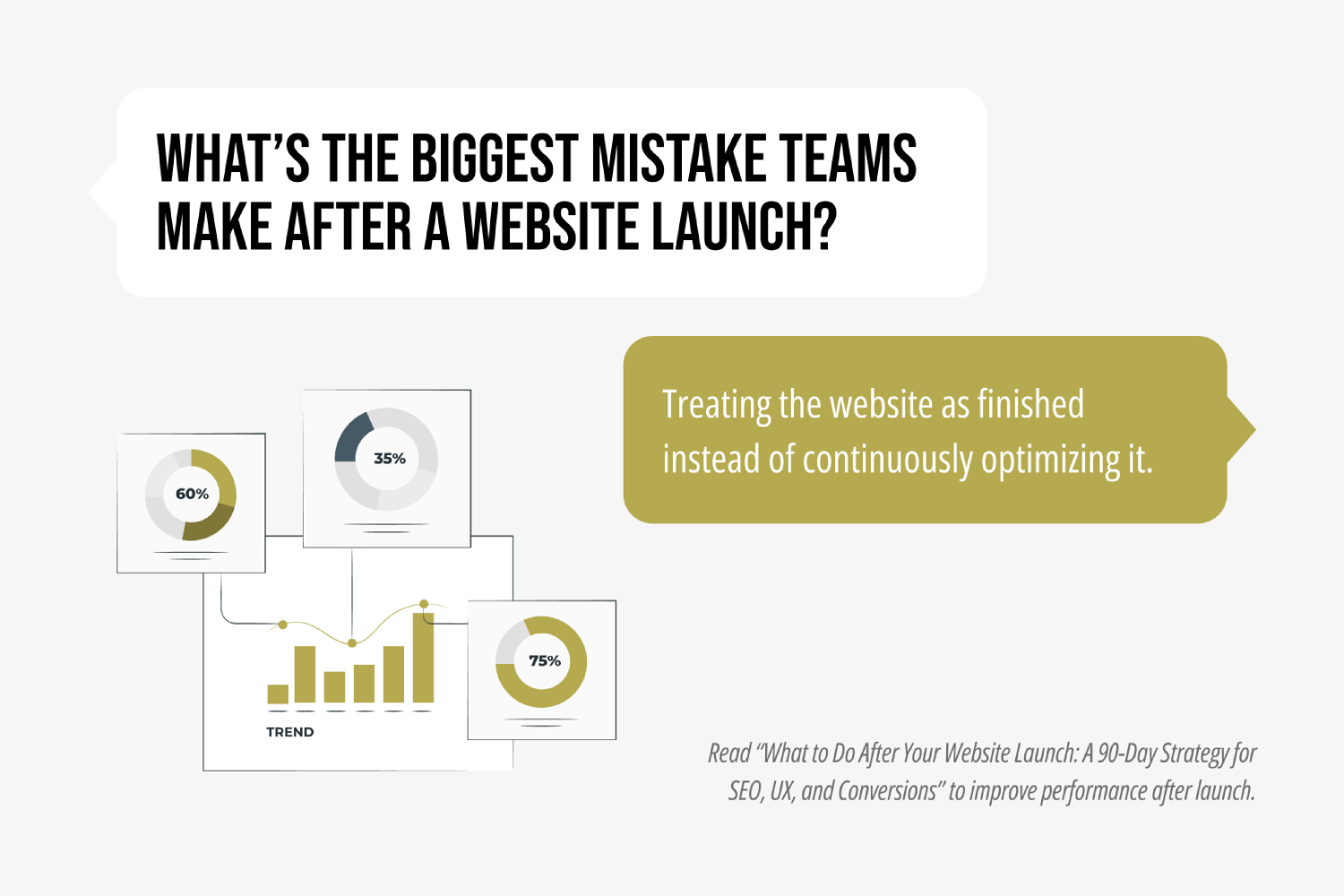
Treating the website as finished instead of continuously optimizing it based on real user behavior and performance data.
Should SEO be part of post-launch strategy?
Yes. SEO is one of the most critical components in the first 90 days, especially after a redesign or migration.
What should marketing teams prioritize first?
Understanding user behavior and identifying performance gaps before making large-scale changes.
If your website recently launched, or is about to, it’s not too late to turn it into a high-performing growth engine. The difference comes from what you do next.
Book a free 30-minute consult to evaluate your website’s first 90-day performance strategy.
Is your website
holding you back?
Take our quick audit to discover what’s working—and what’s not. In just 5 minutes, we’ll help you assess your site’s performance, identify gaps, and get a tailored action plan to move forward.
Take Free Audit
