


- All
- Advertising + Marketing
- Branding
- Case Studies
- Environmental Design + Tradeshows
- Mission-Driven Marketing
- SEO, GEO + Digital Marketing
- Web Design + Development
Is your advertising and marketing strategy working?
Take our short, free audit to assess the strength of your ad and marketing campaigns.
Take Free Audit
Posted by Anya Sleezer
Last Updated on: May 16, 2026
At a Glance
High-performing marketing teams don’t succeed because they collect more data — they succeed because they turn analytics into action. This article explains how data-driven marketing helps mid-sized businesses improve ROI, optimize performance across all marketing investments, and make smarter decisions under budget pressure. We’ll cover what successful teams actually measure, how analytics inform strategy across branding, advertising, experiential, PR, SEO, content, websites, email marketing, and generative engine optimization (GEO) — and how to transform insights into measurable growth in an AI-driven search landscape.
Table of Contents
- 1. Why Data-Driven Marketing Is the Difference Between Activity and ROI
- 2. Why Most Marketing Data Doesn’t Improve Results
- 3. What High-Performing Teams Actually Measure
- 4. Data-Driven Marketing Across Every Channel
- 4.1 Brand Positioning + Creative Effectiveness
- 4.2 Paid Media + Investment Allocation
- 4.3 Experiential Marketing + Event Influence
- 4.4 Earned Media + Authority Building
- 4.5 Sales Enablement + Revenue Impact
- 4.6 Search, Content + Conversion Experience
- 4.7 AI Discovery + Generative Visibility (GEO)
- 4.8 Campaign Orchestration + Lifecycle Engagement
- 5. Turning Insights Into Action (Not Just Reports)
- 6. FAQs: Data-Driven Marketing Decisions
- 7. Final Thoughts + How Levo Helps
1. Why Data-Driven Marketing Is the Difference Between Activity and ROI
For senior marketing leaders, pressure doesn’t come from doing more marketing — it comes from proving that what you’re doing is moving the business forward. Budgets are scrutinized, expectations are higher, and marketing is expected to show clear impact on growth and revenue.
CMOs, VPs of Marketing, Creative Directors, and Marketing Leaders are expected to:
- Prove ROI across every channel
- Defend budgets with data, not opinions
- Make tradeoffs across brand, demand, and growth initiatives
- Adapt to changing buyer behavior, AI-driven search, and evolving platforms
The challenge isn’t a lack of tools or tactics. It’s that many teams still rely on activity-based marketing instead of outcome-based decision-making.
Data-driven marketing changes that. When analytics guide strategy, marketing becomes more predictable, efficient, and accountable — especially when embedded into a data-driven marketing strategy rather than treated as after-the-fact reporting.
2. Why Most Marketing Data Doesn’t Improve Results
Even highly capable marketing teams track dozens of metrics — yet many still struggle to answer one essential question:
What should we do next?
Here’s where analytics often break down.
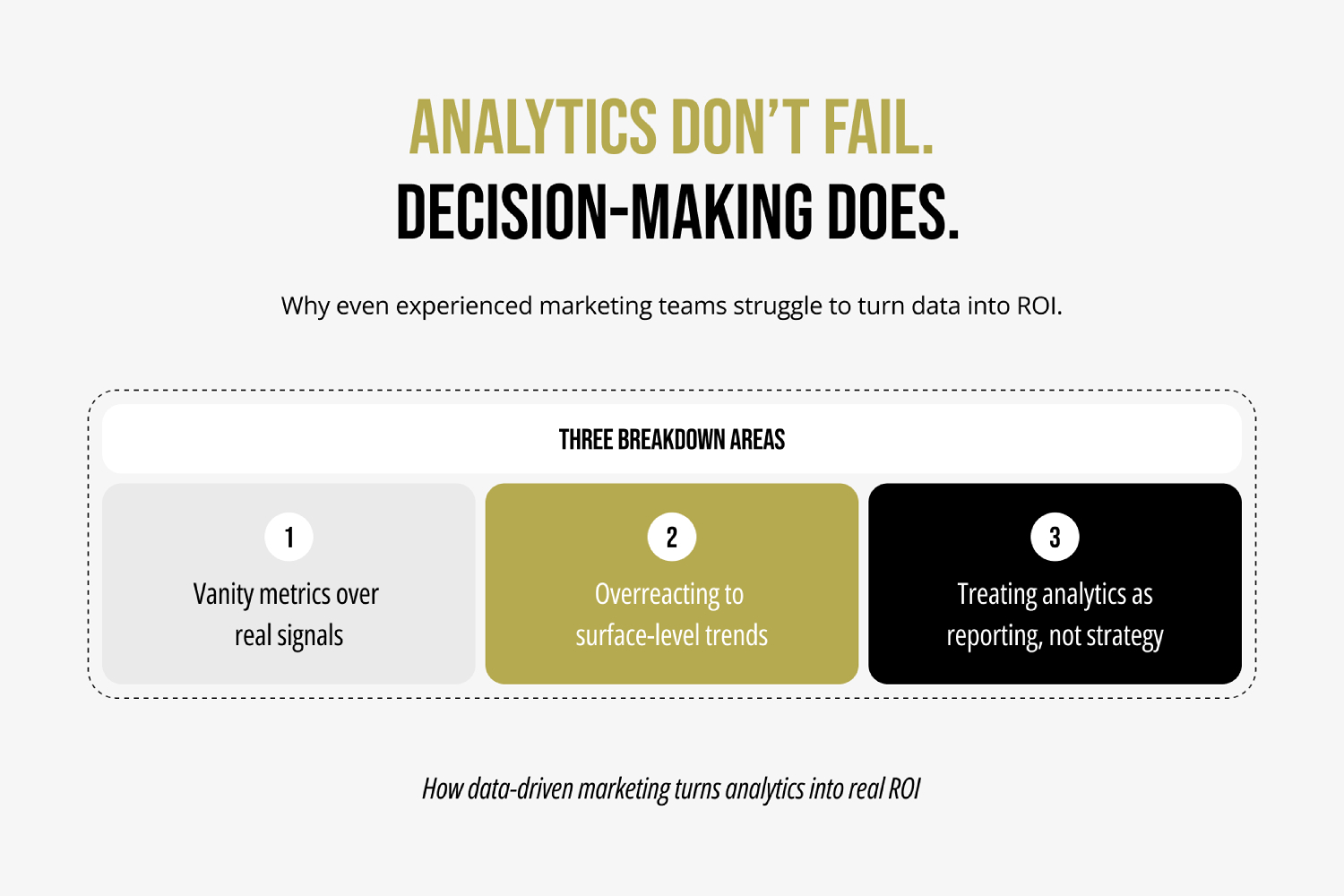
Focusing on Vanity Metrics
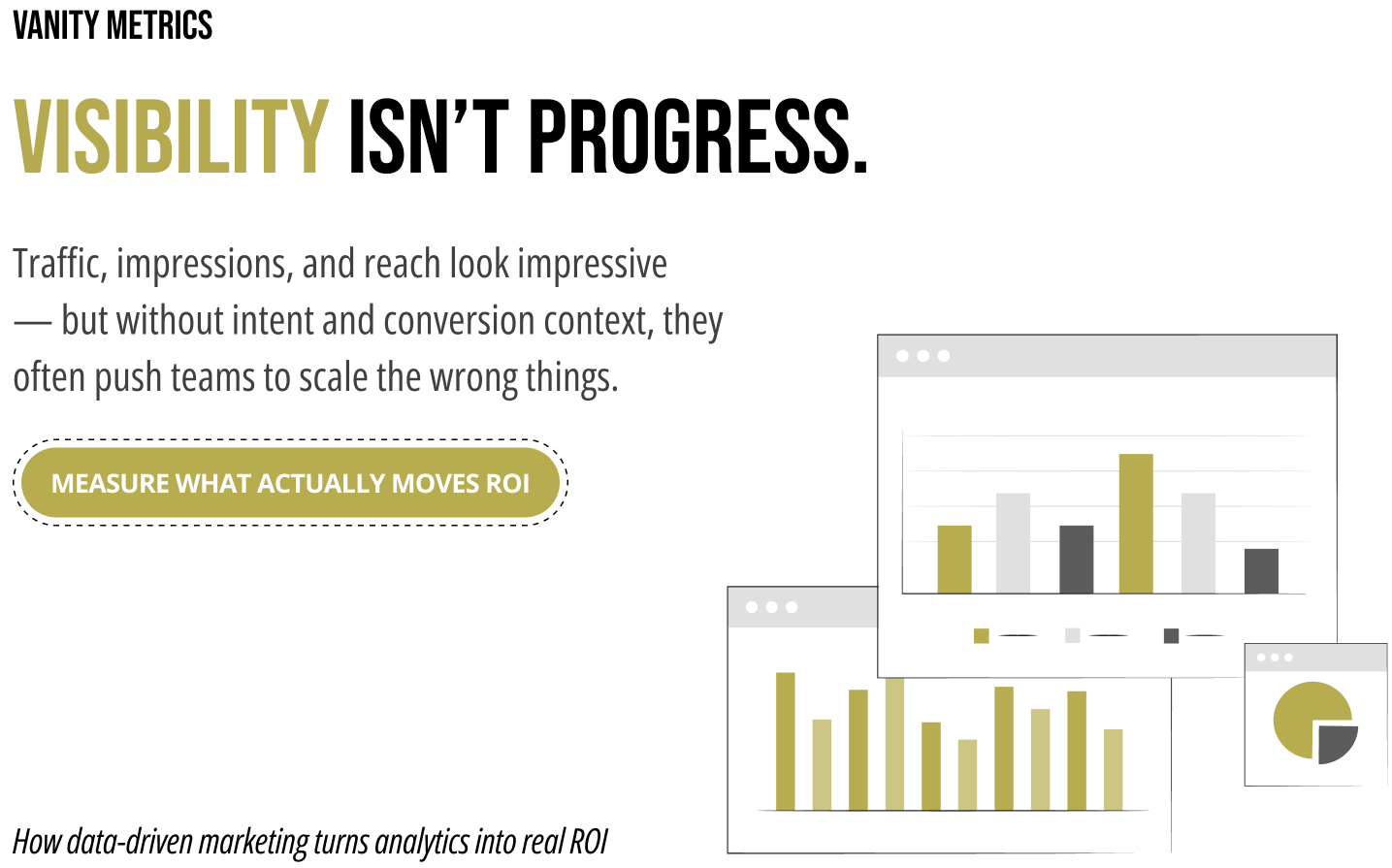
Vanity metrics are a problem when they’re used as decision inputs instead of diagnostic signals. Traffic, impressions, and reach can indicate awareness — but without context around intent, conversion, and downstream impact, they often lead teams to scale the wrong things.
This breakdown usually shows up when success is defined too early in the funnel:
- Optimizing for traffic instead of qualified demand
- Scaling campaigns based on impressions, not conversion quality
- Prioritizing reach without understanding audience intent
Teams optimize for visibility instead of progress, mistaking momentum for performance. It’s one of the most common issues uncovered when auditing underperforming marketing programs, where surface-level gains hide deeper inefficiencies.
Treating Analytics as Reporting, Not Strategy
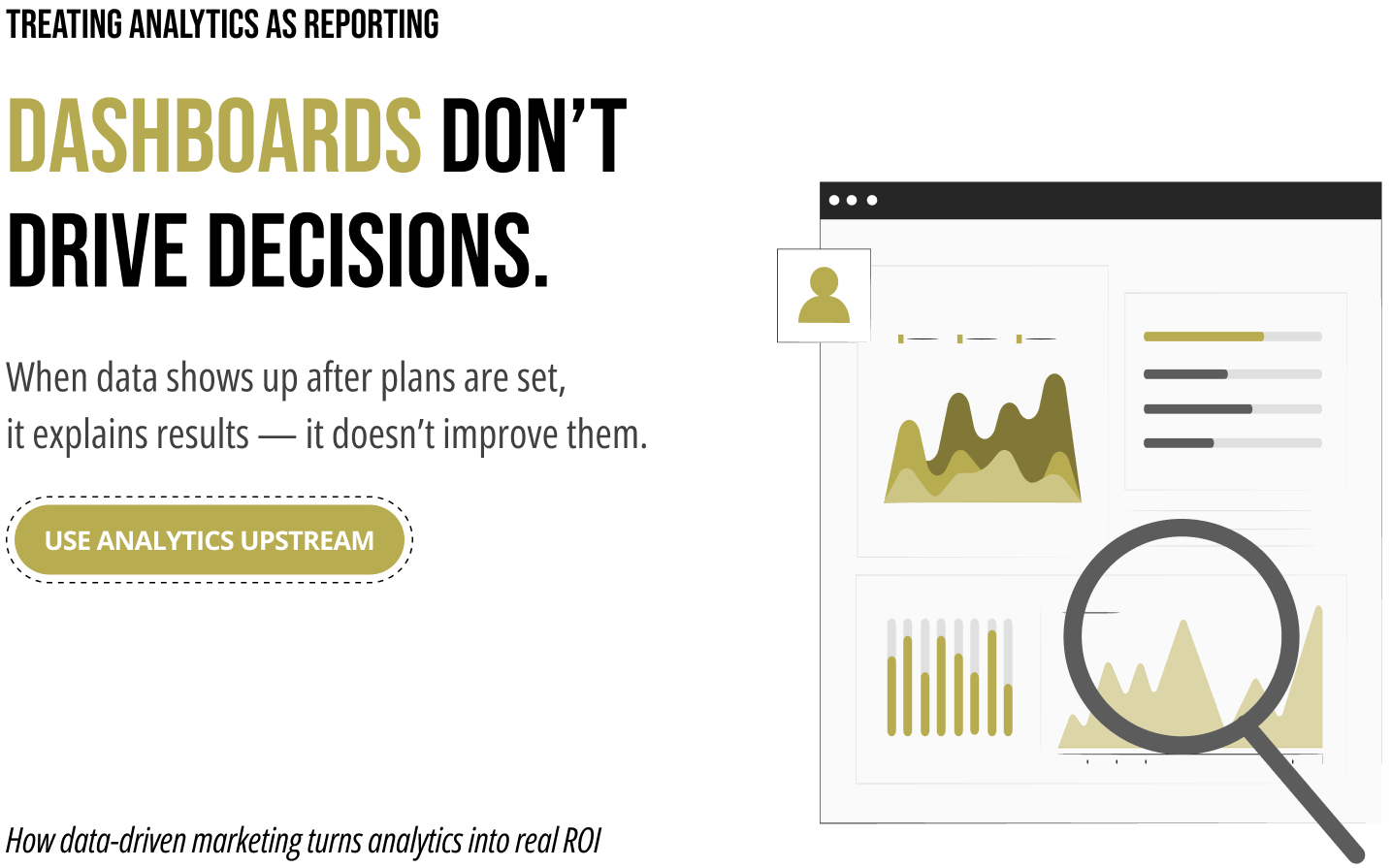
Analytics should inform marketing decisions before plans are finalized — not just summarize performance after the fact. For many teams, this shows up as:
- Annual plans built on last year’s assumptions
- Budgets locked before scenarios are modeled
- Creative approved without clear success criteria
A more effective approach is using analytics upstream to pressure-test priorities:
- What deserves increased investment?
- What should be cut or deprioritized?
- Where is performance strong enough to scale — and where is it masking deeper issues?
Without this shift, dashboards may look sophisticated while decision-making remains reactive.
Overreacting to Surface-Level Trends
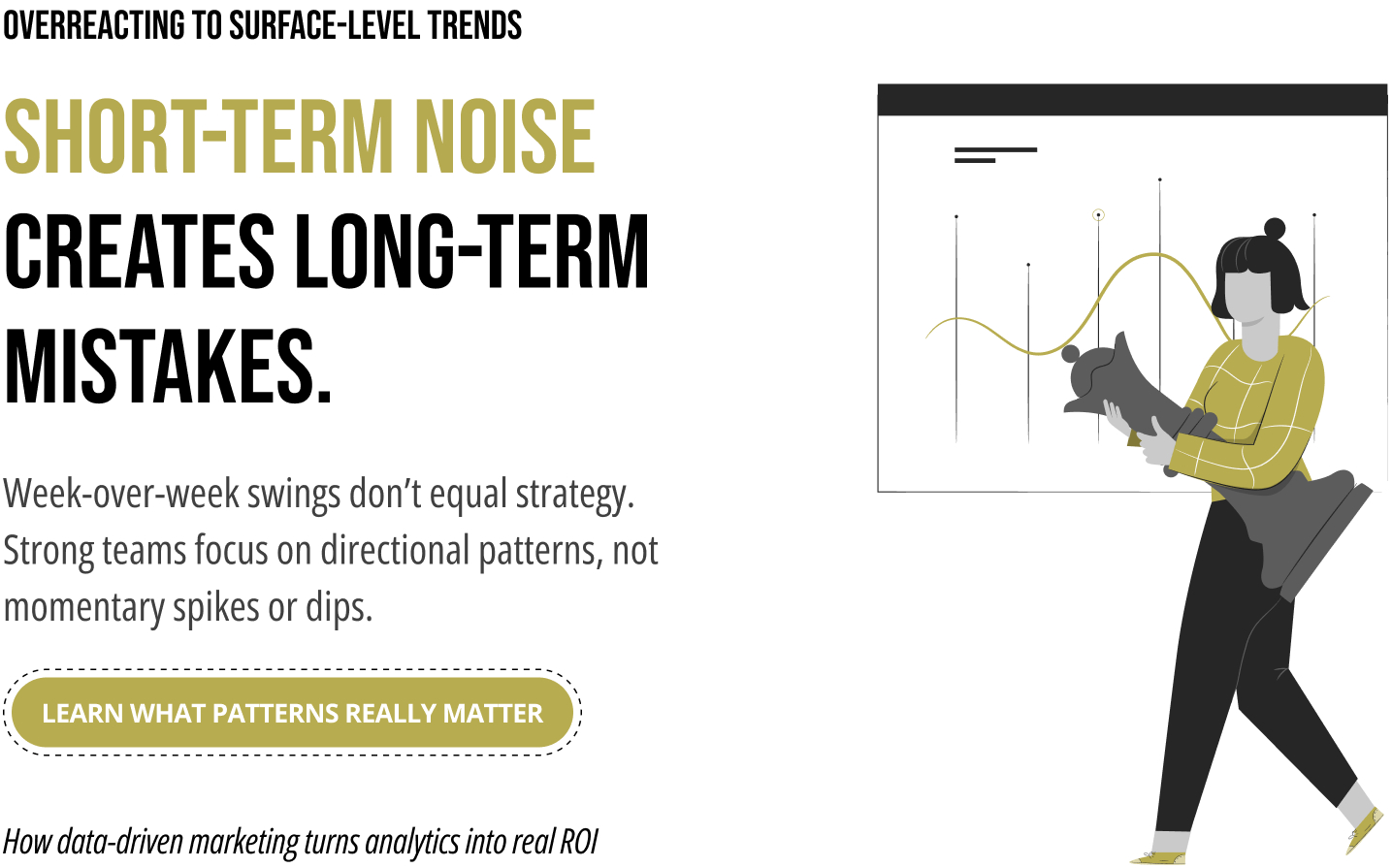
Analytics break down when teams react to short-term fluctuations without understanding causality. Common triggers include:
- A dip in traffic
- A spike in cost per lead
- A short-term drop in engagement
More experienced teams look for directional patterns and leading indicators instead of week-over-week noise, such as:
- Sustained improvements in conversion rate
- Rising branded search demand
- Higher-quality leads progressing through the funnel
- Consistent engagement gains across multiple touchpoints
In many cases, fewer visitors paired with higher conversion rates signal stronger targeting and improved intent. Without this context, teams risk chasing volatility instead of building sustained performance.
3. What High-Performing Teams Actually Measure
High-performing marketing teams don’t win by tracking more — they win by tracking better. The most successful data-driven teams are selective about what they measure and ruthless about tying metrics back to business outcomes. They focus on metrics that directly influence ROI.
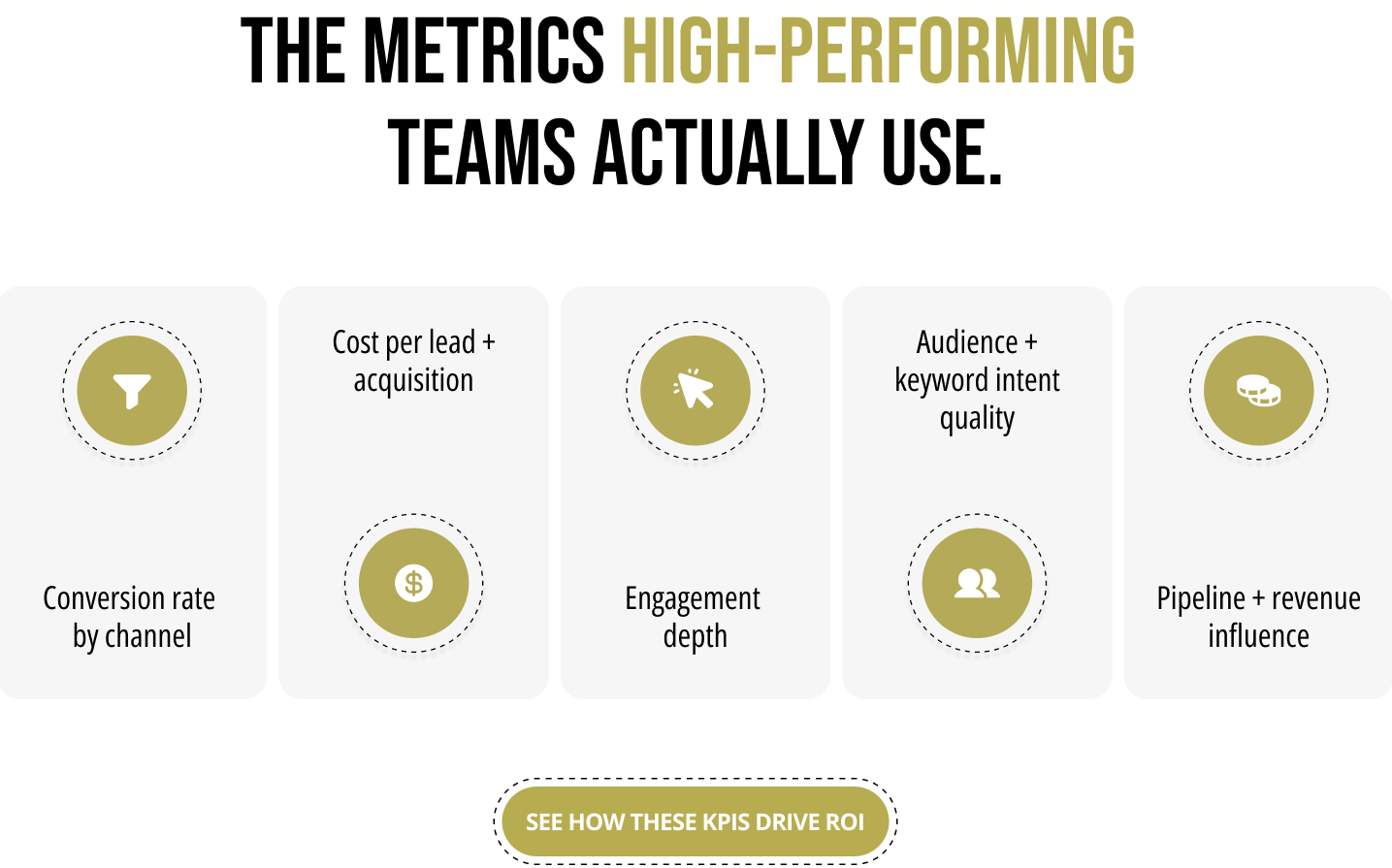
Marketing KPIs That Matter
- Conversion rate by channel and touchpoint
- Cost per lead and cost per acquisition
- Engagement signals (time on site, depth of interaction, key events)
- Audience and keyword intent quality
- Lead source contribution to pipeline and revenue
These KPIs are most effective when they’re aligned to the buyer’s journey, ensuring marketing performance is measured by progression and influence — not just volume.
4. Data-Driven Marketing Across Every Channel
A more subtle—and far more costly—challenge for experienced marketing teams is not whether they analyze and adjust, but when analytics enter the decision-making process. The biggest ROI gains come when data is used upstream—to shape priorities, guide investment decisions, and stress-test assumptions—before budgets are locked or creative is finalized, not simply as a reporting layer once campaigns are live.
Data doesn’t replace strategy, creativity, or intuition. It sharpens them, informing where to invest, what to prioritize, and how to adapt across every discipline.
4.1 Brand Positioning + Creative Effectiveness
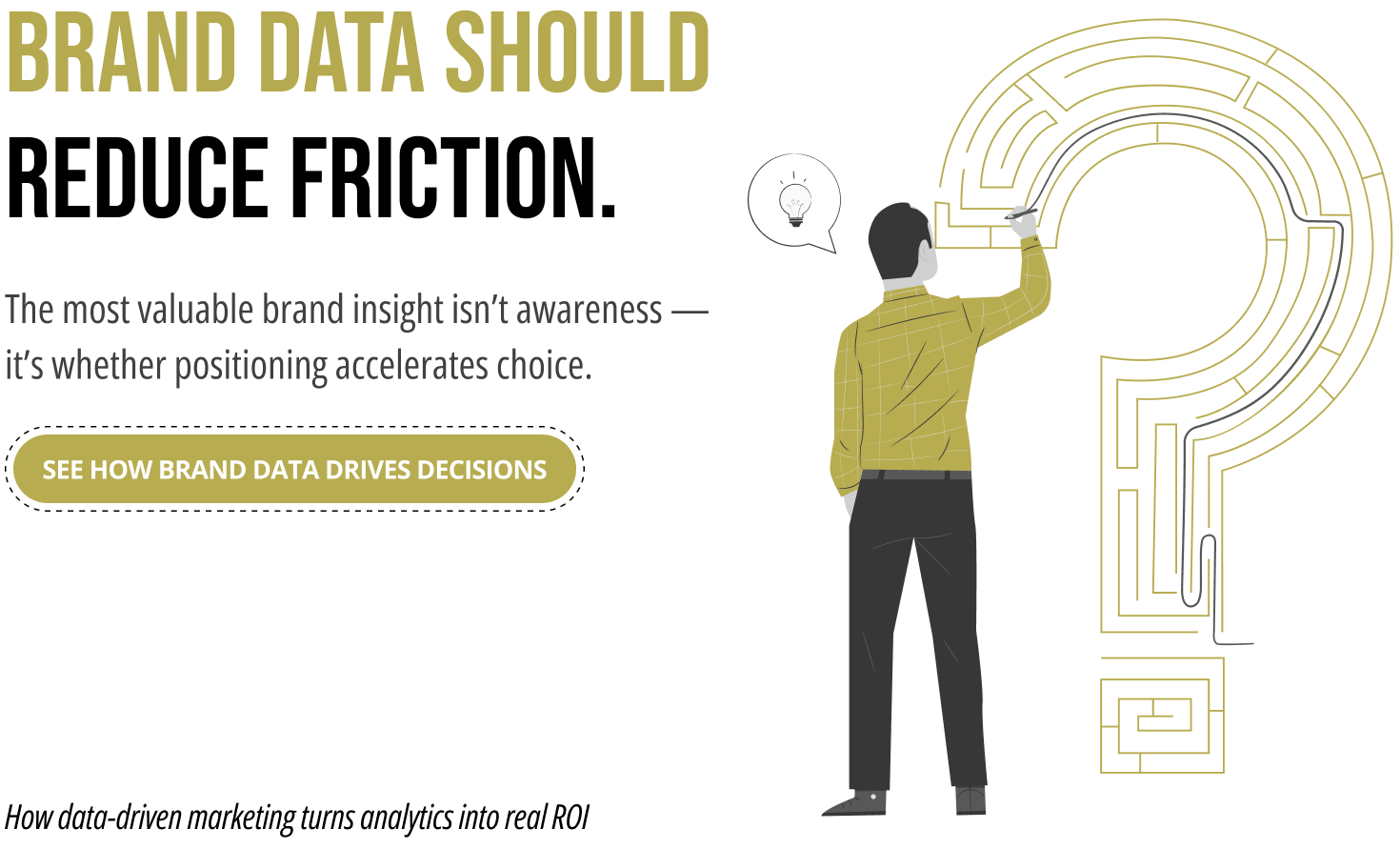
For experienced teams, the challenge isn’t measuring brand performance — it’s translating brand signals into confident investment decisions. The most valuable brand data doesn’t answer “do people like us?” but “is our positioning reducing friction and accelerating choice?”
High-performing teams look beyond surface awareness and focus on:
- Message-level engagement that correlates with downstream conversion or sales velocity
- Audience recall and comprehension tied to specific narratives, not campaigns
- Creative-driven conversion lift across segments (what works where, not just what works)
- Content interaction depth as a proxy for clarity and relevance
When brand data is weak or inconsistent, it often signals a positioning issue — not a creative execution problem. This is a common pattern explored in Why Your Brand Story Isn’t Working and Avoid These Common Brand Development Pitfalls, where strong creative fails to perform because the underlying narrative isn’t doing enough strategic work. That’s where performance data becomes a strategic input, not a postmortem.
4.2 Paid Media + Investment Allocation
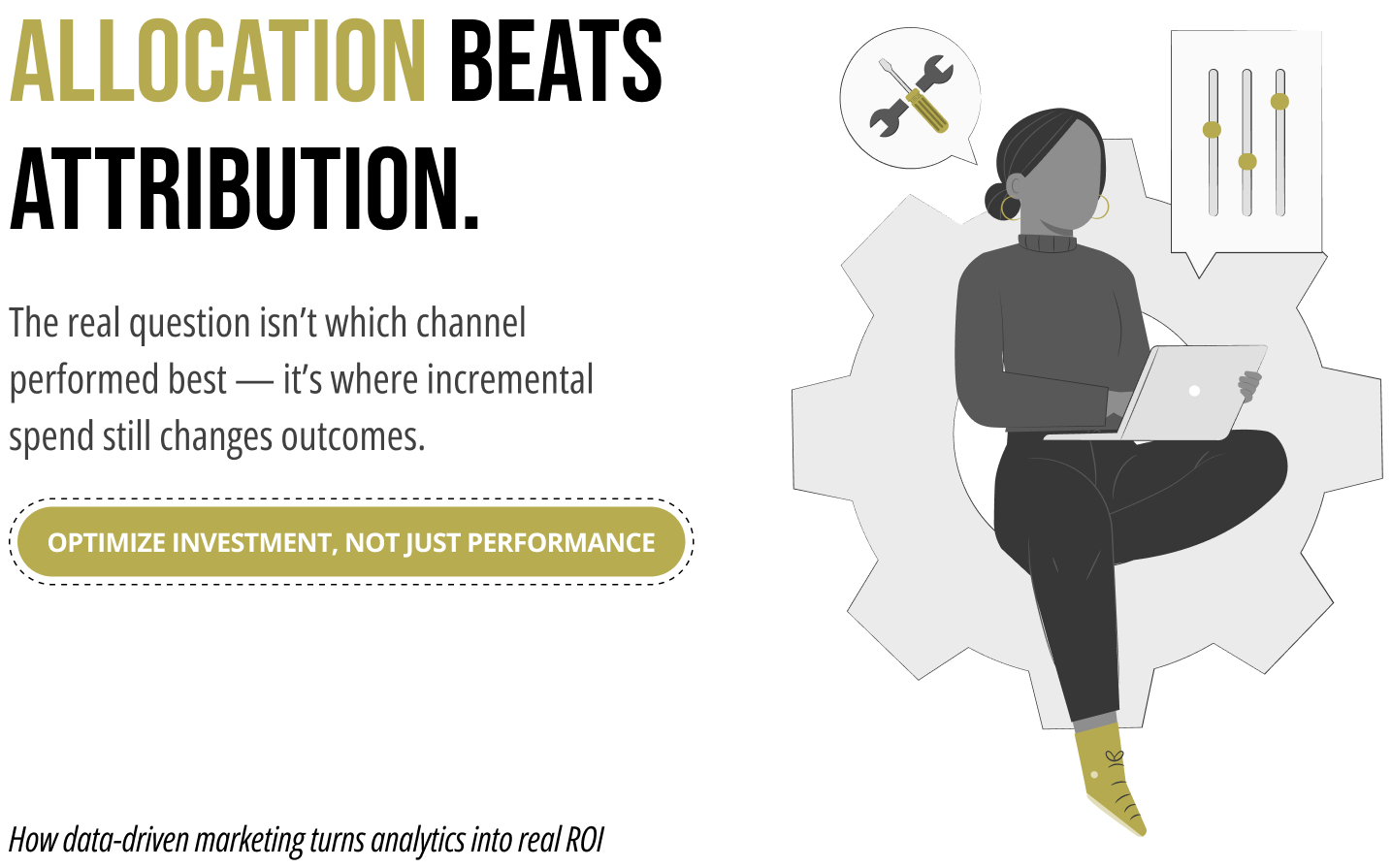
The biggest data challenge in advertising isn’t attribution — it’s allocation. Experienced teams already know no single channel works in isolation. The real question is how much inefficiency they’re willing to tolerate while chasing reach or experimentation.
Advanced teams use data to:
- Model marginal returns by channel, not just average performance
- Identify when additional spend creates diminishing impact
- Separate creative fatigue from channel fatigue
Rather than asking “which channel performed best,” they ask “where does incremental spend still change outcomes?” Frameworks like the RACE marketing framework help structure these decisions across reach, act, convert, and engage stages.
4.3 Experiential Marketing + Event Influence
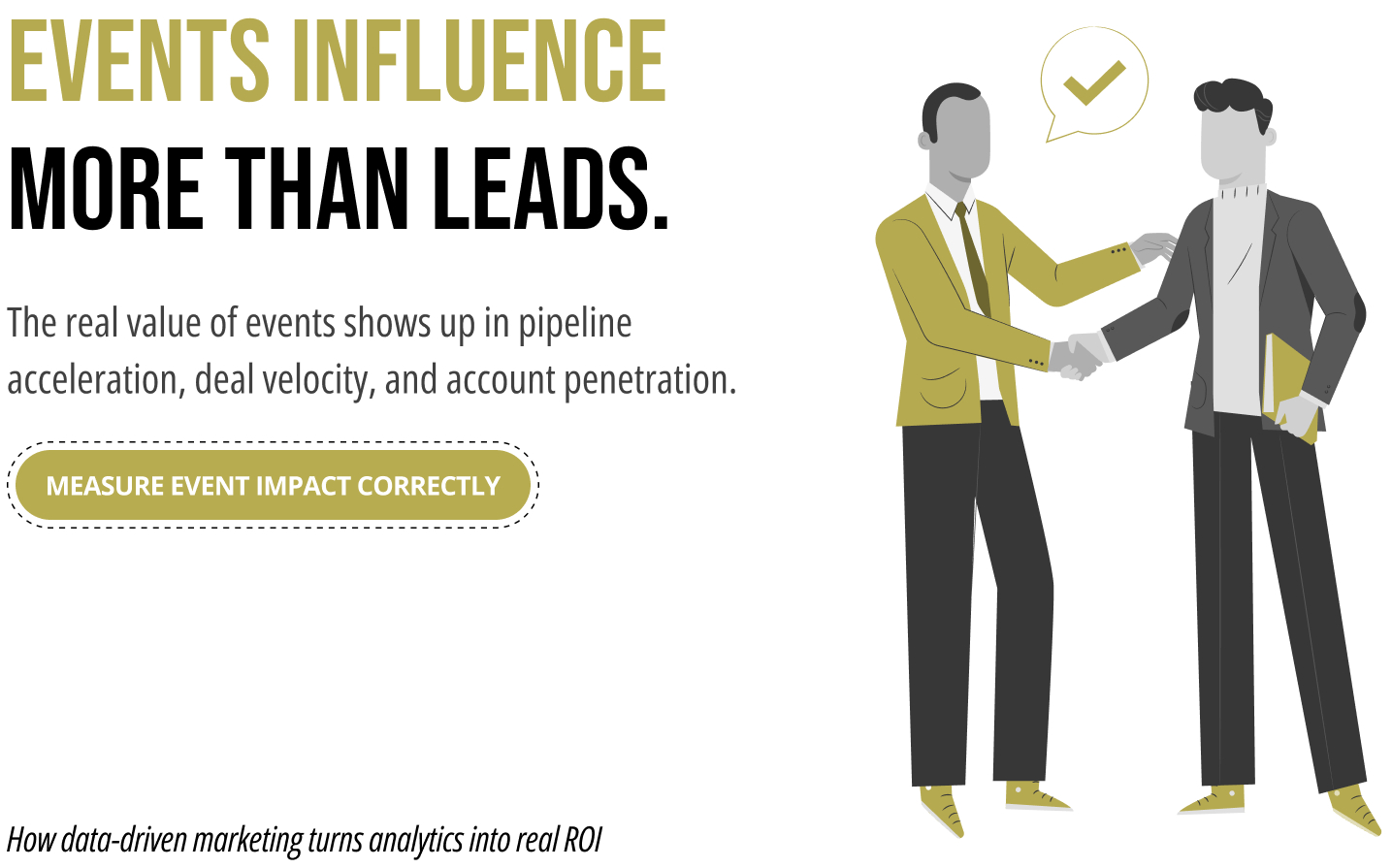
For experiential investments, the data problem isn’t measurement — it’s signal loss. Too many teams reduce events to lead counts, ignoring the strategic value of influence, acceleration, and account penetration.
More sophisticated teams evaluate events based on:
- Pipeline acceleration for accounts touched at events
- Deal influence and progression speed post-event
- Experience quality signals that predict follow-up effectiveness
This shifts events from a cost center to a strategic lever — especially when paired with intentional post-event activation. Guides like Plan to Win: Your Free Guide to an Unforgettable Trade Show Booth and Six Tips to Turn Tradeshow Attendees Into Customers show how experienced teams translate engagement into pipeline impact.
4.4 Earned Media + Authority Building
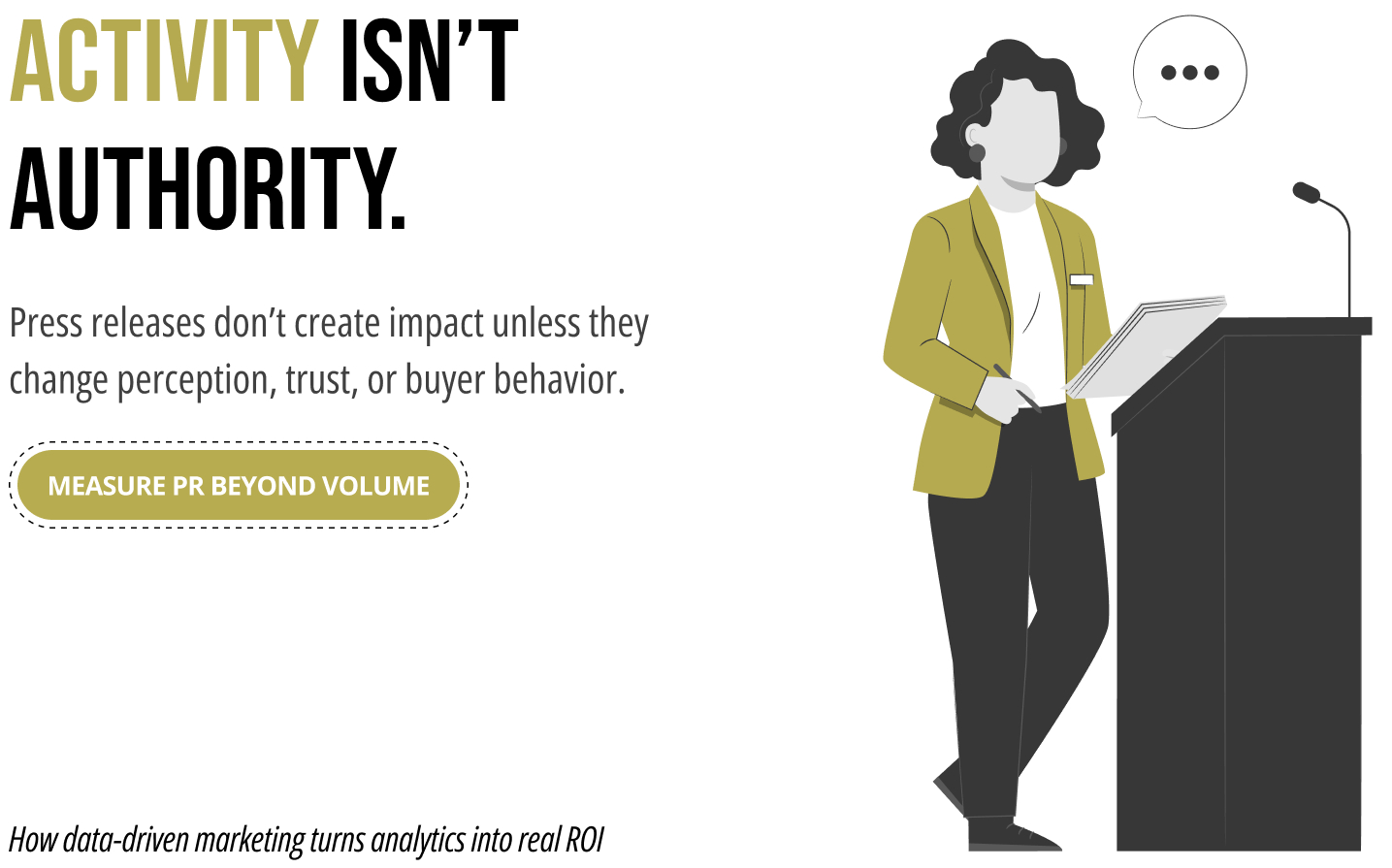
PR data breaks down when teams mistake activity for impact. Publishing frequent press releases or chasing backlinks may create the appearance of momentum, but when no one reads, remembers, or acts on the message, the data is signaling noise — not authority or demand.
For experienced teams, the real question isn’t “are we consistent?” — it’s “are we relevant to how buyers think, search, and decide right now?”
High-performing teams use data to evaluate PR through a different lens:
- Whether coverage reinforces or changes buyer perception, not just whether it exists
- How often core messages are repeated and recognized across outlets (message pull-through)
- Search behavior shifts following coverage, including branded and problem-based queries
- Downstream engagement from earned placements, not just referral traffic
When PR is measured this way, it becomes a compounding asset. It shapes narrative authority, strengthens trust signals for search and AI systems, and supports conversion indirectly by reducing skepticism long before a buyer ever clicks or fills out a form.
4.5 Sales Enablement + Revenue Impact
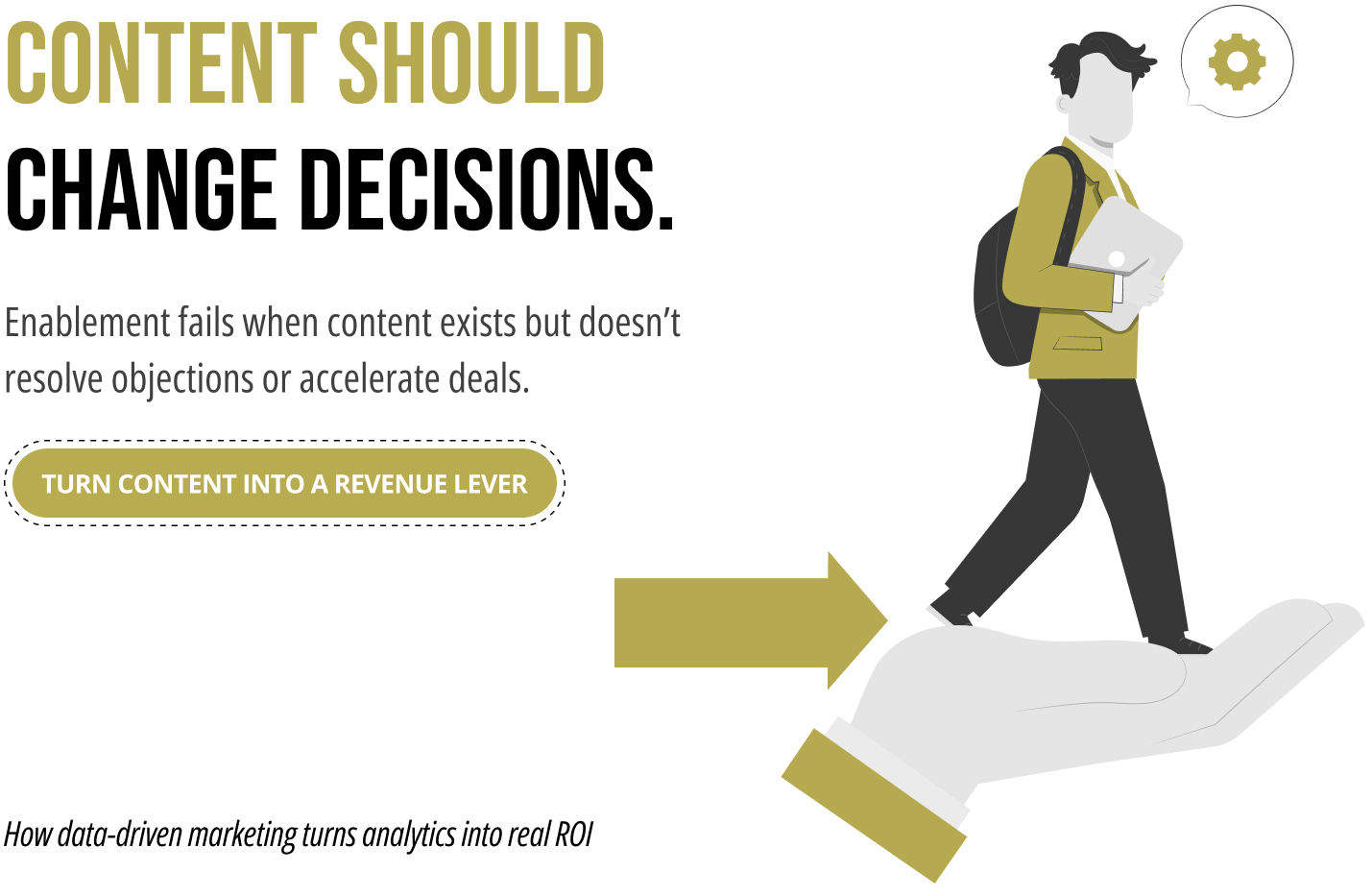
The deeper data blind spot in enablement isn’t whether content exists or whether it’s being used — it’s whether content is actually changing buyer behavior at critical moments of decision. Many experienced teams track downloads, views, and sales adoption, but those metrics rarely explain why deals stall, slow, or derail.
High-performing teams look beyond asset usage and focus on:
- Where in the deal cycle content is introduced — and whether that timing accelerates or delays decisions
- Which questions or objections content resolves (and which it fails to address)
- Patterns where sales consistently bypass official materials in favor of custom explanations
- Content gaps that force sales to recreate narratives deal by deal
When enablement data is analyzed this way, content becomes a diagnostic tool. It reveals friction in the buyer’s decision process, exposes misalignment between marketing and sales assumptions, and highlights where messaging clarity — not volume — is the real growth constraint.
This shifts enablement from a content library to a decision-support system that directly influences revenue outcomes. Creating content that performs this role requires more than consistency — it requires intentional value, clarity, and usefulness at the moment of decision, as outlined in High-Value Content Checklist: Six Tips to Create Search-Friendly, Share-Worthy Content.
4.6 Search, Content + Conversion Experience
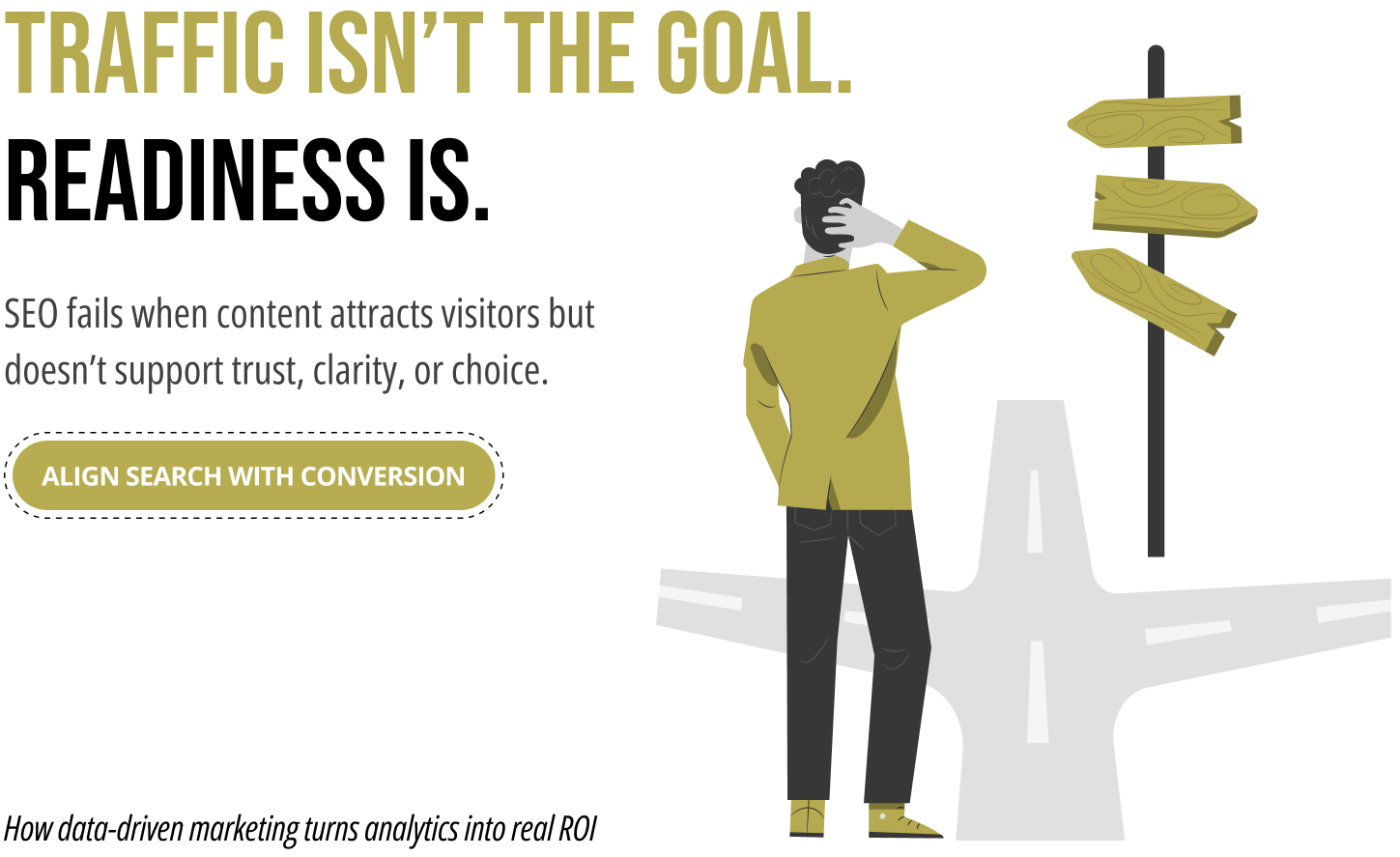
The biggest SEO blind spot for experienced marketing teams isn’t keyword strategy or technical optimization — it’s mistaking traffic acquisition for decision readiness. Many teams successfully grow search visibility but fail to evaluate whether that traffic is actually prepared to choose, trust, or convert.
High-performing teams use search and content data to answer harder questions:
- Which pages reduce buyer uncertainty versus simply attract clicks
- Where search traffic stalls because content lacks proof, specificity, or differentiation
- How different intent types (informational, comparative, evaluative) convert at different rates
- Which content accelerates decisions and which merely educates
When SEO data is viewed this way, rankings become a starting point — not the goal. Search performance becomes a signal of how well content supports decision-making, not just discoverability.
For teams looking to operationalize this, the Ultimate SEO Checklist is more helpful than generic best practices because it forces teams to validate whether SEO fundamentals are actually supporting conversion — not just traffic growth.
4.7 AI Discovery + Generative Visibility (GEO)
For most experienced marketing teams, the GEO challenge isn’t awareness — it’s clarity. Leaders know AI-driven discovery matters, but few can point to which decisions should actually change because of it.
The real shift isn’t just zero-click influence. AI compresses the consideration stage, pushing buyers from problem recognition to perceived consensus faster and with fewer brand-controlled touchpoints.
That creates a blind spot most analytics can’t see. Traditional data explains what happens after engagement. GEO exposes what happens before — when assumptions, shortlists, and perceived expertise are formed externally, often without a site visit.
High-performing teams use GEO-related signals to diagnose:
- Whether their expertise appears consistently across problem-level questions, not just branded or solution queries
- How AI systems frame their category — and which competitors are positioned as defaults or authorities
- Gaps between how the brand intends to be perceived and how it is summarized or synthesized by AI tools
- Which topics are shaping early confidence, even when no interaction is recorded
This reframes the strategic question from “How do we optimize for AI?” to:
Where are buyers forming certainty before we ever meet them — and how well are we influencing that moment?
For many mid-sized and enterprise teams, GEO becomes less about rankings and more about risk management: reducing the chance that incomplete, outdated, or competitor-driven narratives define the brand upstream. As AI reshapes discovery, teams are reassessing how owned content, thought leadership, and authority signals work together — a shift explored in Your Website vs. AI: Winning Traffic Back in the Age of ChatGPT and Google AI.
4.8 Campaign Orchestration + Lifecycle Engagement
The deeper data blind spot in campaigns and lifecycle marketing isn’t open rates or even engagement — it’s misattribution of impact across time. Many experienced teams evaluate campaigns in isolation, without understanding how messages compound (or conflict) across the full buyer journey.
The result is often well-executed campaigns that underperform because they’re disconnected from prior context, downstream expectations, or sales motion. Performance issues show up not because emails fail, but because buyers receive messages out of sequence with their readiness to act.
High-performing teams use lifecycle data to examine: – How campaign timing aligns with buyer intent signals, not just calendar schedules
- Whether messages reinforce or contradict earlier brand, PR, or content touchpoints
- Where engagement drops because messaging assumes too much knowledge or urgency
- How campaign exposure over time influences conversion velocity, not just response rates
When lifecycle data is analyzed this way, campaigns stop being judged as individual sends and start being evaluated as a system. Email becomes most powerful when treated as an orchestration layer — sequencing messages to reduce friction, reinforce confidence, and move buyers forward at the pace they’re actually ready for.
For deeper guidance, Agency-Managed Email Marketing Campaigns and Don’t Get Unsubscribed: Grow Your Mid-Sized Business with These Four Email Marketing Tips explore how data-driven lifecycle programs sustain engagement without over-messaging or eroding trust.
5. When Analytics Change Direction (Not Just Optimize)
The real gap between analytics and ROI isn’t willingness — it’s decision friction. Experienced marketing teams don’t ignore data; they struggle to act on it when tradeoffs are real, ownership is unclear, and risk isn’t evenly shared.
The most common failure mode isn’t continuing to fund poor performers — it’s holding onto legacy investments too long because they feel safer, more visible, or politically entrenched.
High-performing teams use analytics to do harder things than incremental optimization: – Force prioritization. Rank initiatives against each other, not in isolation. – Clarify tradeoffs. Decide explicitly what to stop doing — even when something is working marginally. – Shift resources upstream. Reallocate budget and effort earlier, before inefficiencies compound.
Analytics becomes powerful when it enables these decisions. The teams that extract real ROI from data aren’t the ones with the best dashboards — they’re the ones willing to let data change direction, not just confirm momentum.
This shift increasingly requires new capabilities inside marketing teams. As platforms, AI, and buyer behavior evolve, leaders are rethinking the skills their organizations need to interpret data, manage tradeoffs, and guide strategy — a theme explored in The Skills Marketers Need in 2026.
6. FAQs: Data-Driven Marketing Decisions
1. What does data-driven marketing actually mean at a leadership level?
Data-driven marketing means using analytics to inform directional decisions — where to invest, what to stop, and how to prioritize — not just to report on performance. For senior teams, it’s less about dashboards and more about decision confidence.
2. Why do experienced teams still struggle to improve ROI with analytics?
The challenge usually isn’t access to data. It’s decision friction: competing priorities, legacy investments, and unclear ownership that slow action even when insights are clear.
3. How do you know which marketing metrics actually matter?
The most useful metrics are those tied to buyer progression and business outcomes — such as conversion quality, pipeline influence, and decision velocity — rather than surface-level activity metrics.
4. How does GEO change how marketers should think about performance?
GEO highlights what happens before engagement. It forces teams to evaluate how their brand, expertise, and narratives shape buyer confidence upstream, even when no clicks or sessions are recorded.
5. Do mid-sized companies need enterprise-level tools to be data-driven?
No. The biggest gains come from clearer questions and better decision-making frameworks, not more technology. Most teams already have the data they need — they just need to use it more strategically.
7. Final Thoughts: Analytics Turn Marketing Into a Growth Engine
Marketing doesn’t improve because teams collect more data. It improves when analytics are used to reduce uncertainty, surface tradeoffs, and guide decisive action.
For experienced marketing leaders, the real value of analytics isn’t optimization — it’s alignment. Data helps teams agree on what matters most, move resources with confidence, and adapt as buyer behavior and discovery continue to evolve.
When analytics shape priorities before budgets are locked and campaigns are launched, marketing becomes more efficient, accountable, and resilient.
That’s how analytics stop being reports — and start driving real ROI.
Ready to Turn Your Marketing Data Into Measurable ROI?
At Levo, we help mid-sized businesses build data-driven marketing strategies that connect analytics to real business outcomes — across brand, digital, experiential, SEO, GEO, and performance marketing.
Book a free strategy consult with Levo to evaluate your current performance, uncover growth opportunities, and build a future-ready, data-driven marketing roadmap.
Is your advertising and marketing strategy working?
Take our short, free audit to assess the strength of your ad and marketing campaigns.
Take Free Audit
