


- All
- Advertising + Marketing
- Branding
- Case Studies
- Environmental Design + Tradeshows
- Mission-Driven Marketing
- SEO, GEO + Digital Marketing
- Web Design + Development
How strong is your
brand, really?
Take our short free audit to find out where your brand stands—and how to turn
strategy into impact. (It only takes 2 minutes—and can unlock the clarity your
brand needs to thrive.)

Posted by Anya Sleezer
Last Updated on: May 16, 2026
At a Glance
Mission-driven marketing rarely fails because organizations lack purpose. It fails because the internal marketing process isn’t structured to interpret data strategically, close perception gaps, embed trust architecture, and integrate mission into SEO, GEO, and funnel design.
In this article, we count down the seven mistakes — from early warning signs to the structural failure that determines whether your mission scales or stalls. Each mistake compounds the next, ultimately revealing the structural issue that determines whether your mission drives measurable growth.
Disciplined execution turns mission into measurable performance. But only when the process supports it.
Table of Contents
- 1. The Real Reason Mission-Driven Marketing Fails
- 2. The Real Cost of These Mistakes — Ranked from Least to Most Expensive
- 3. Mistake #7: Mistaking Constant Activity for Strategic Clarity
- 4. Mistake #6: Assuming the Market Understands the Mission the Way You Do
- 5. Mistake #5: Defining Mission Abstractly Instead of Operationally
- 6. Mistake #4: Monitoring Metrics Without Interpreting Patterns
- 7. Mistake #3: Optimizing Conversion Before Building Trust Architecture
- 8. Mistake #2: Adding Mission Language Without Rebuilding the Funnel
- 9. Mistake #1: Treating Mission as Branding Instead of a Growth Engine
- 10. Why SEO and GEO Amplify These Gaps
- 11. How to Build a Mission-Driven Growth Engine
- 12. FAQs
- 13. Turn Purpose Into Performance
The Real Cost of These Mistakes
- Mistake #7: Mistaking constant activity for strategic clarity creates inefficiency.
- Mistake #6: Assuming the market understands the mission the way you do creates perception gaps.
- Mistake #5: Defining mission abstractly instead of operationally weakens strategic clarity.
- Mistake #4: Monitoring metrics without interpreting patterns prevents insight from turning into action.
- Mistake #3: Optimizing conversion before building trust architecture reduces trust at the moment of decision.
- Mistake #2: Adding mission language without rebuilding the funnel distorts your funnel.
- Mistake #1: Treating mission as branding instead of a growth engine undermines discoverability and long-term growth.
Fixing early mistakes improves performance. Fixing the final mistake transforms it.
The Real Reason Mission-Driven Marketing Fails
Mission-driven marketing fails in the process — not the purpose. Most organizations have meaningful missions. They generate impact. They care deeply.
The breakdown happens inside execution.
Teams are busy. Campaigns launch. Ads run. Emails deploy. Social posts publish. Trade shows get staffed. Collateral gets updated. Dashboards refresh. Everything is moving. But motion is not the same as alignment.
Mission-driven marketing strategy requires more than tactical execution. It requires disciplined interpretation, structural refinement, and someone empowered to step back and ask whether every channel reinforces the same strategic direction.
Without that structure, growth plateaus.
The 7 Costly Mistakes – Ranked from Least to Most Expensive
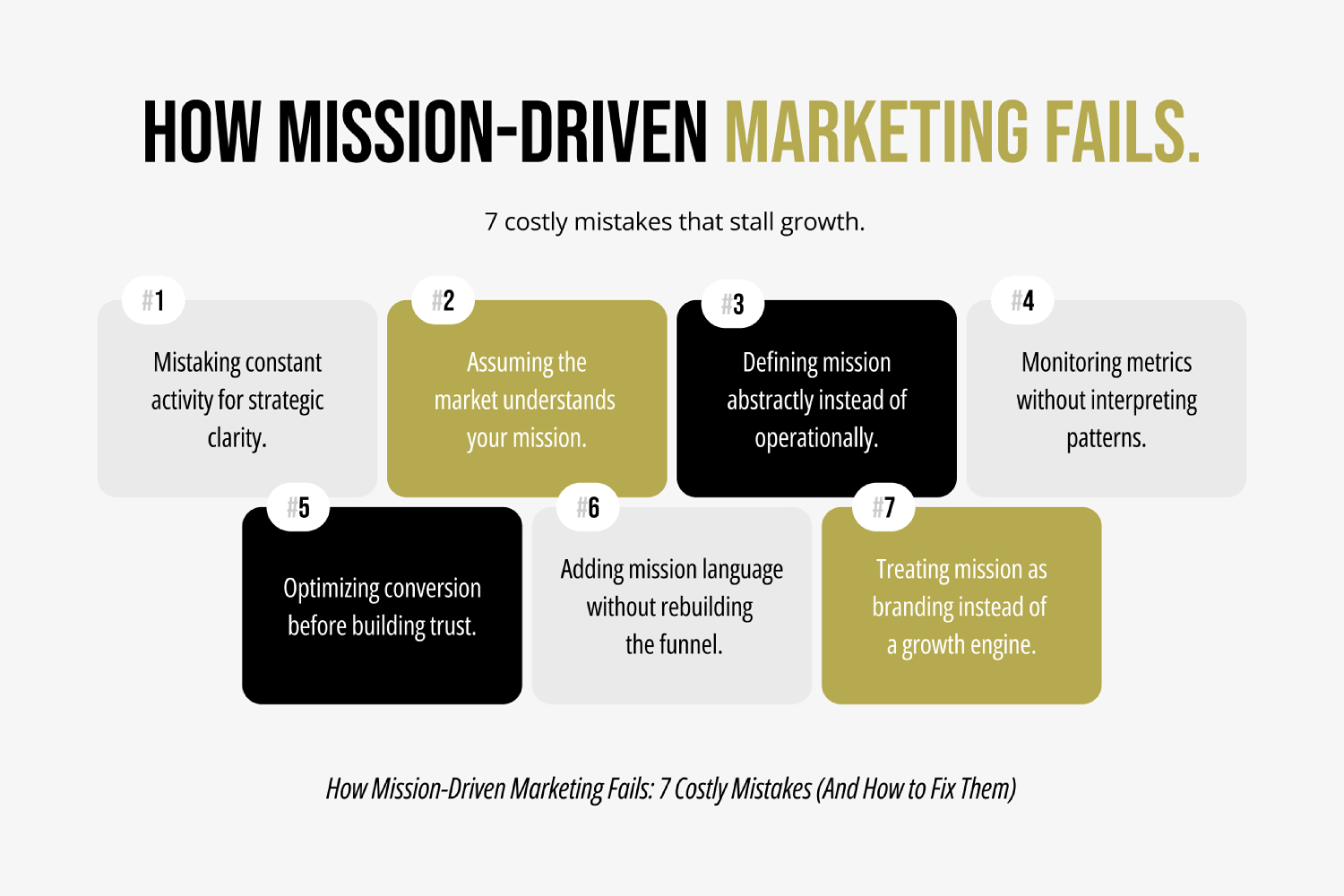
Mission alone doesn’t drive growth. Execution does. These 7 structural mistakes quietly stall mission-driven marketing.
Mistake #7: Mistaking Constant Activity for Strategic Clarity
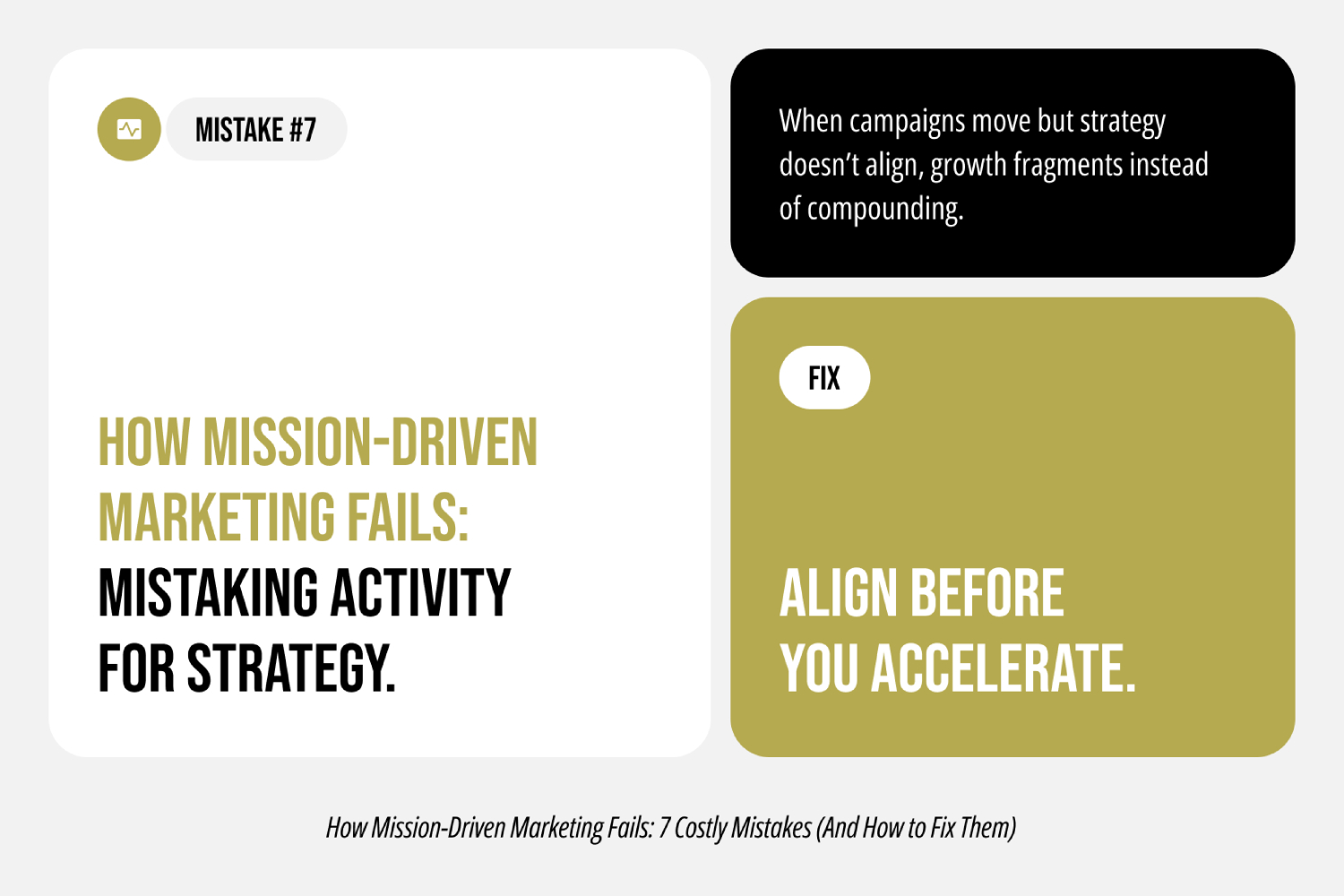
Busy isn’t the same as strategic. Activity without alignment fragments growth.
This is not a data problem. It is a focus problem. Marketing teams are in perpetual motion. Creative ships. Campaigns adjust. Budgets shift. Performance reports update.
But when teams are overtaxed, activity replaces integration.
Messaging shifts slightly between ads and email. Trade show positioning differs from website language. Sales decks emphasize different proof points than paid campaigns. Everything performs, but nothing compounds.
The result is fragmentation. Clarity compounds. Activity does not.
How to fix it: Create structured strategy integration cycles separate from campaign execution. Define 2–3 strategic pillars that every channel must reinforce. Assign ownership for cross-channel coherence. If your channels feel disconnected, our guide to the RACE framework outlines how to structure awareness, engagement, conversion, and retention into a cohesive growth system.
If you’d like to see the shift from fragmented effort to strategic clarity, explore how we helped MorseLife unify recruitment, internal mission, and marketing tactics into a cohesive authority narrative rooted in dignity, trust, and measurable impact. Strong activity was already present — alignment across channels transformed it into compounding engagement.
Mistake #6: Assuming the Market Understands the Mission the Way You Do
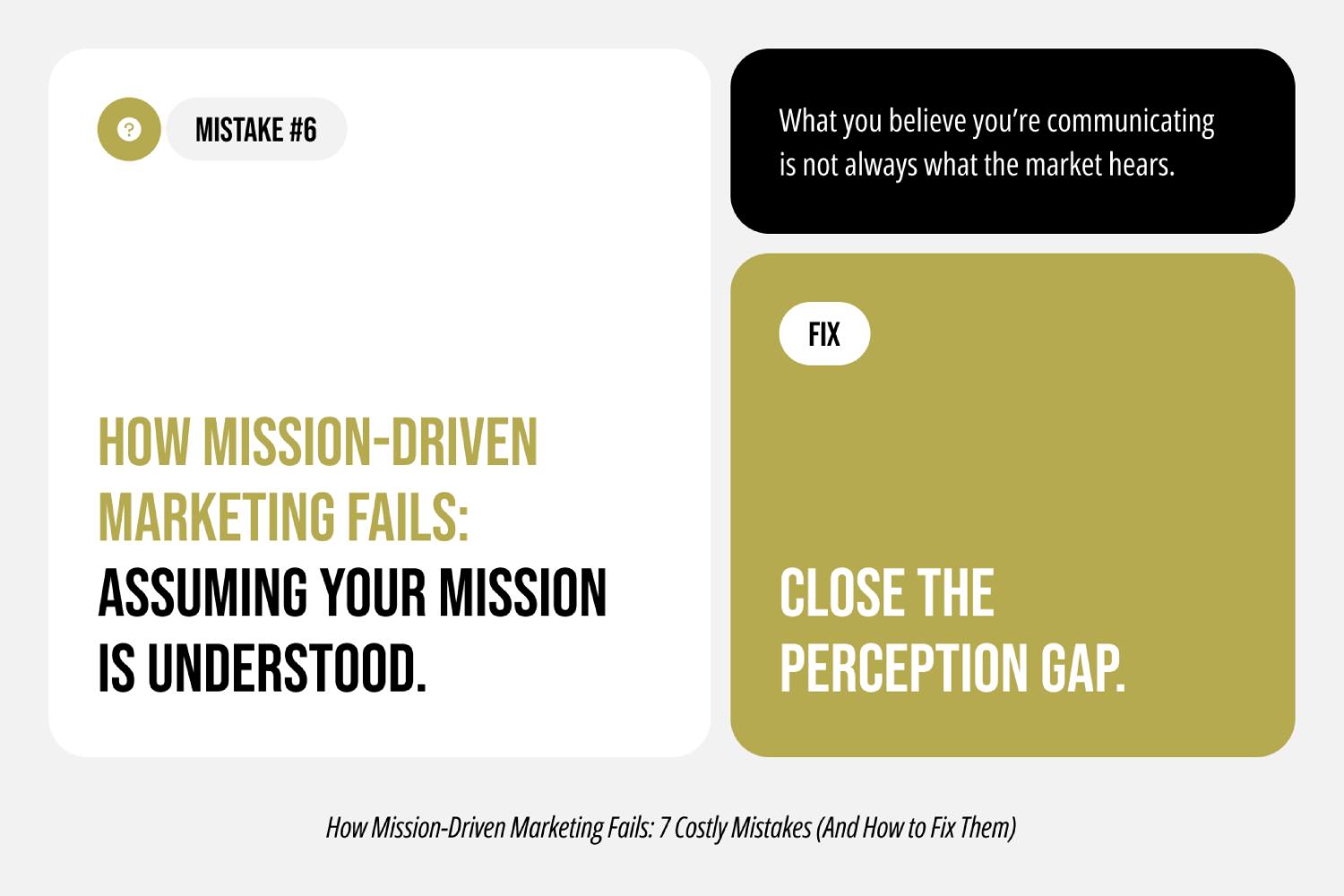
Your mission may be clear internally — but the market hears something different.
Internal teams live the mission every day. They believe it clearly and deeply. They assume the audience does too. That assumption creates perception gaps.
Without structured audience validation—research interviews, facilitated discussions, or feedback analysis—teams reinforce internal narratives rather than correcting misalignment. What you believe you are saying is not always what prospects hear.
How to fix it: Compare internal positioning with external interpretation. Refine clarity based on research, not assumption. If you’ve struggled to articulate what truly differentiates you, explore why your brand story isn’t working — and how a RallyPoint can fix it. Sustained alignment between what you intend to communicate and what the market actually believes is what builds durable brand equity — reinforced through consistent positioning and proof over time.
If you’d like to see how perception gaps reshape positioning, explore how we helped Fox Cleaners close the gap between leadership’s desired brand image and how customers actually described the experience. Through structured research and brand development, we translated those insights into a clarified brand and customer-centric positioning that aligned internal intent with external reality and infused it consistently into their marketing and structure.
Mistake #5: Defining Mission Abstractly Instead of Operationally
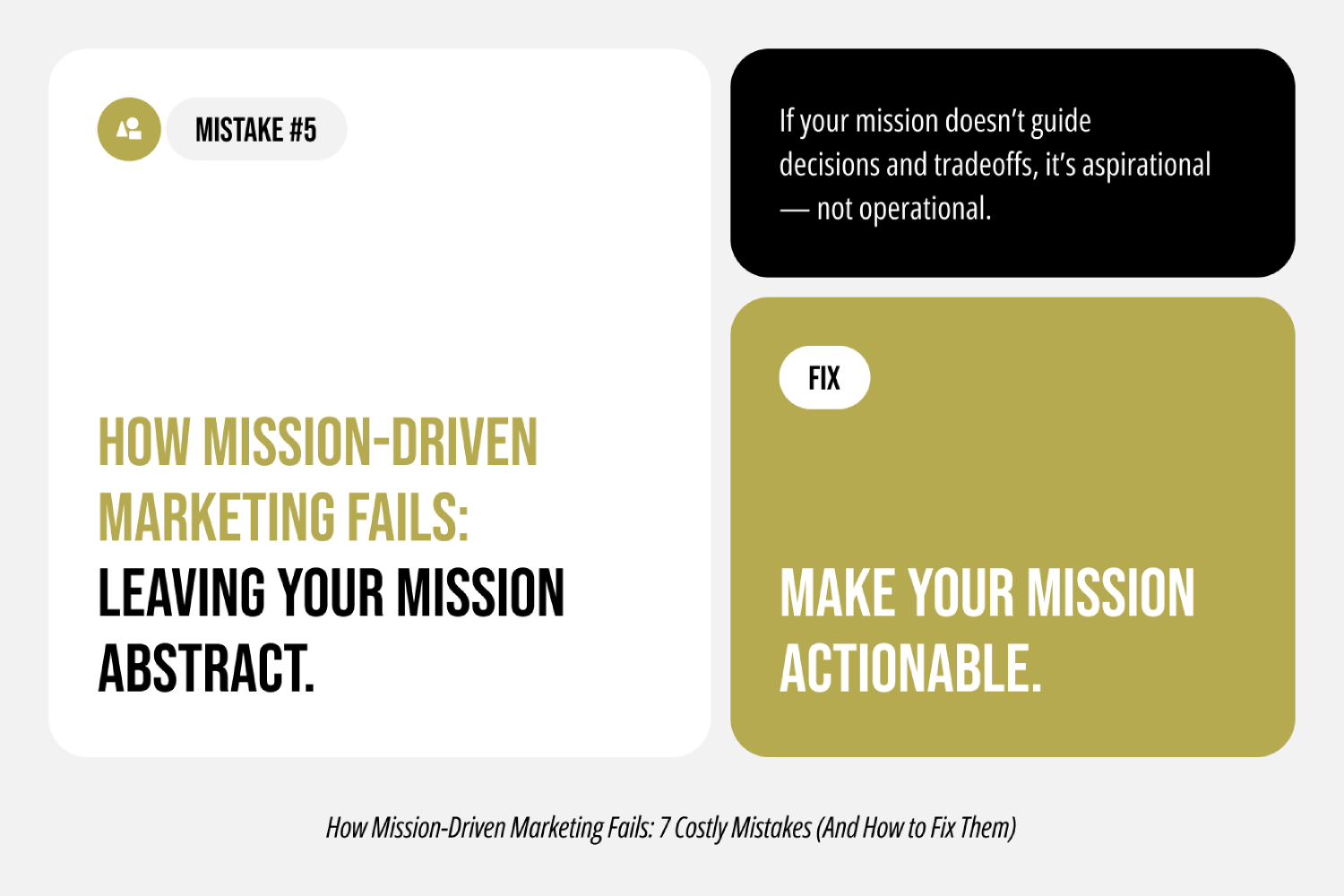
If your mission doesn’t guide decisions, it’s inspiration — not strategy.
Abstract mission language inspires agreement. Operational mission clarity guides decisions.
If your mission does not clarify what you prioritize when resources are limited, what tradeoffs you are willing to make, how decisions differ because of your mission, and where you draw boundaries, it remains aspirational.
Abstract mission inspires. Operational mission directs.
How to fix it: Translate belief into visible decision logic. Make tradeoffs clear. Show how your mission influences real-world choices. If your brand messaging feels aspirational but lacks structural clarity, avoid these common brand development pitfalls that keep mission from becoming actionable strategy.
If you’d like to see mission translated into operational differentiation, explore how we helped SecureDoc, affiliated with Cerebral Palsy Unlimited, clarify how its work expands employment and independence for individuals with developmental disabilities. The mission was powerful internally but abstract externally and tangentially related to their services; we structured it into clear, decision-level value communication that strengthened credibility and positioning.
Mistake #4: Monitoring Metrics Without Interpreting Patterns
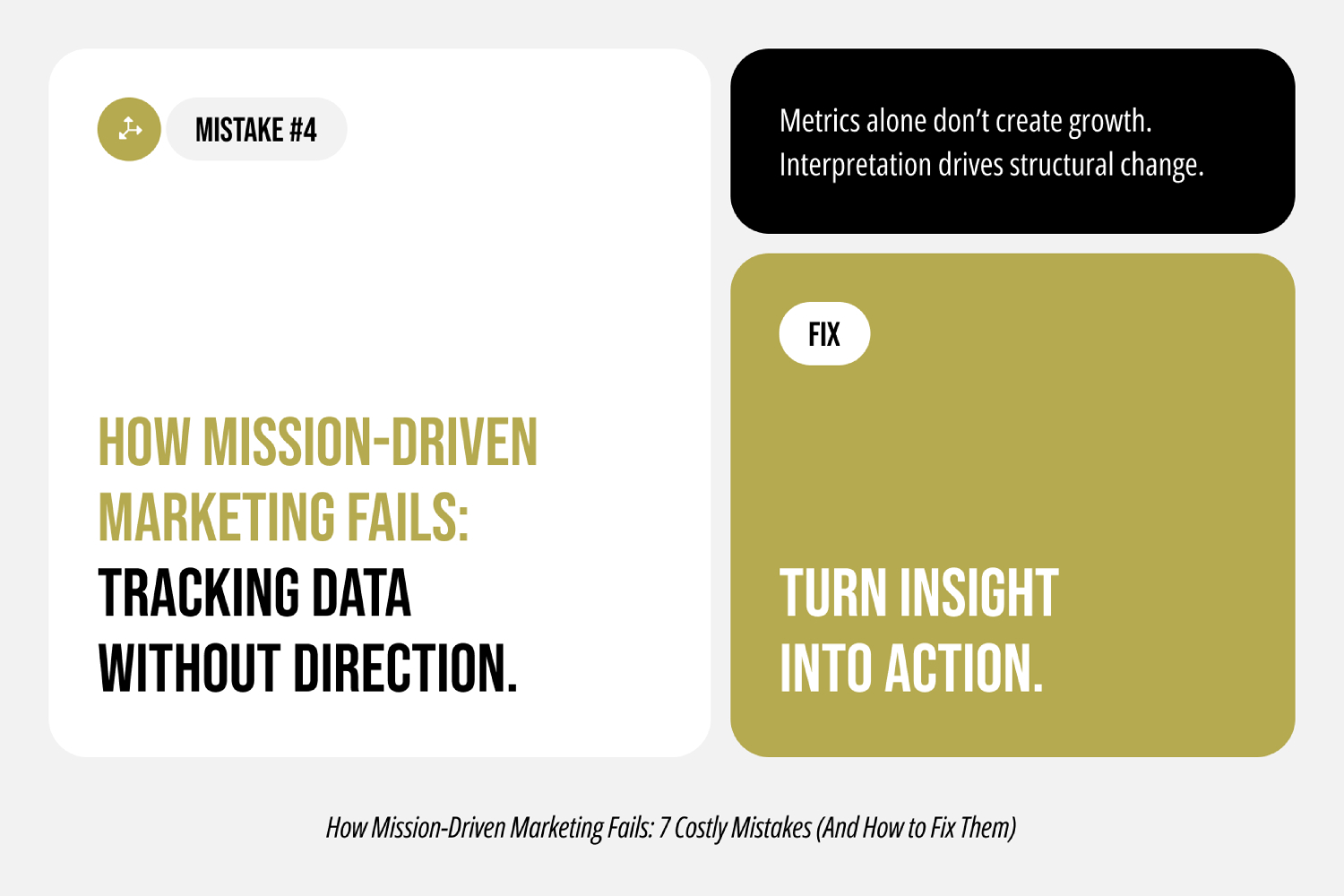
Data doesn’t drive growth. Interpretation does.
Most teams track performance metrics. Fewer interpret them strategically. Data must shape structure, not just dashboards.
Instead of asking only whether performance improved, ask:
- What objections are recurring?
- Where does hesitation increase?
- Which proof reduces evaluation time?
- What channel interactions accelerate trust?
- What search behavior reveals new intent?
How to fix it: Assign ownership for pattern interpretation. Schedule reviews focused on strategic shifts, not just tactical adjustments. If your team tracks performance but struggles to translate insights into directional decisions, our guide on how data-driven marketing turns analytics into real ROI outlines how high-performing teams use analytics to shape priorities before budgets are locked.
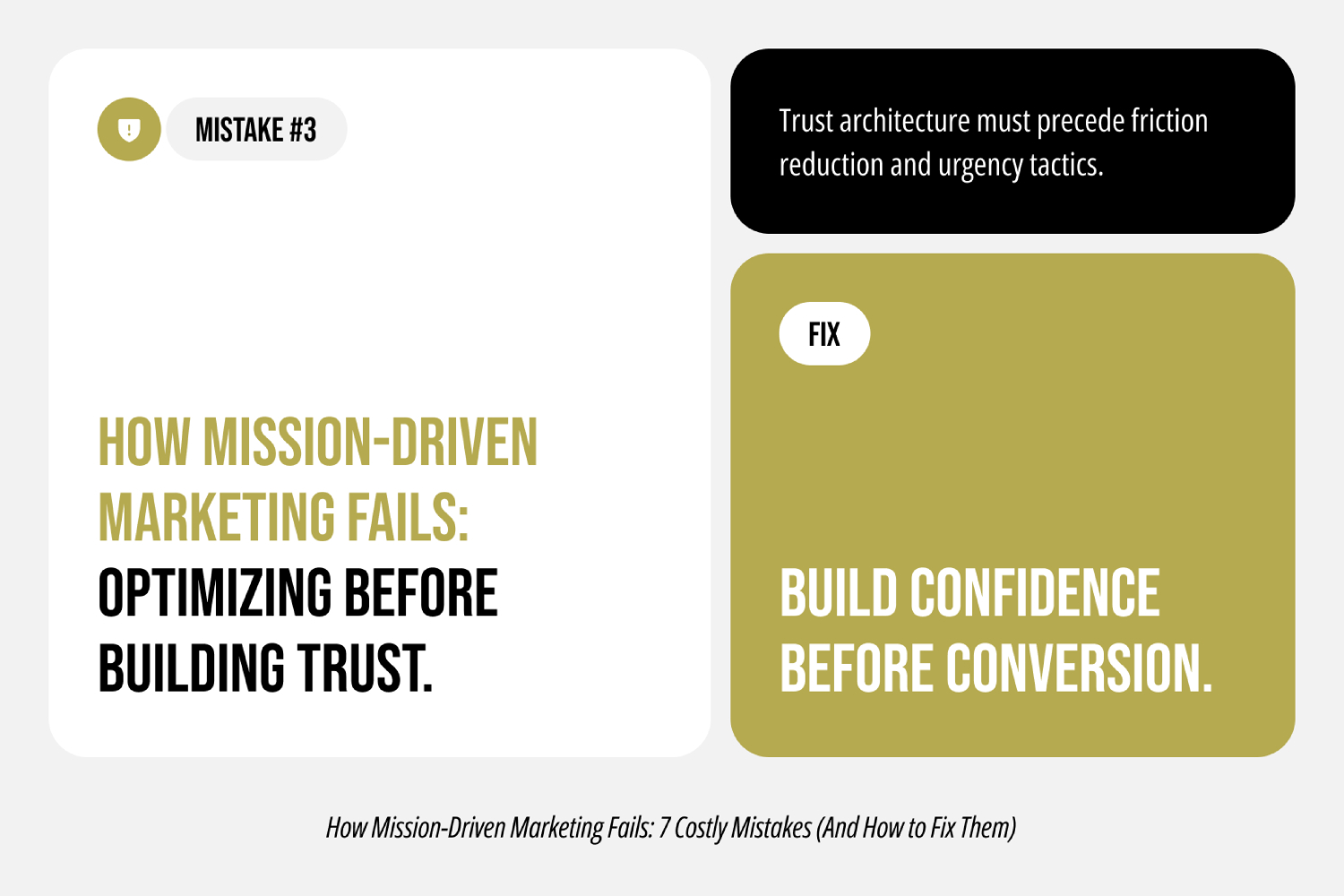
Mistake #3: Optimizing Conversion Before Building Trust Architecture
If your funnel works the same without mission language, the mission isn’t driving strategy.
Many teams prioritize reducing friction. Shorter forms. Fewer clicks. Stronger urgency. But trust architecture must precede conversion mechanics.
Trust architecture includes:
- Visible proof early in the journey
- Transparent explanation of process
- Clear articulation of tradeoffs
- Authority signals across channels
- Case studies aligned to objections
- Structured FAQs that support SEO and GEO discoverability
When confidence increases, conversion improves.
How to fix it: Audit credibility signals before adjusting conversion mechanics. AI-driven search is reshaping how prospects evaluate credibility. Building trust requires content that answers real decision-stage questions and reduces uncertainty. Our High-Value Content Checklist outlines how to create content that supports clarity, credibility, and buyer confidence.
If you’d like to see trust architecture in a public-sector context, explore how we supported the City of Broken Arrow in strengthening transparency and public confidence through financial newsletters, annual reports, and recruitment materials. The challenge wasn’t promotion — it was clarity and accountability. By structuring complex financial and operational information into accessible, trustworthy communication, we reinforced institutional credibility before asking the community to place confidence in its leadership.
Mistake #2: Adding Mission Language Without Rebuilding the Funnel
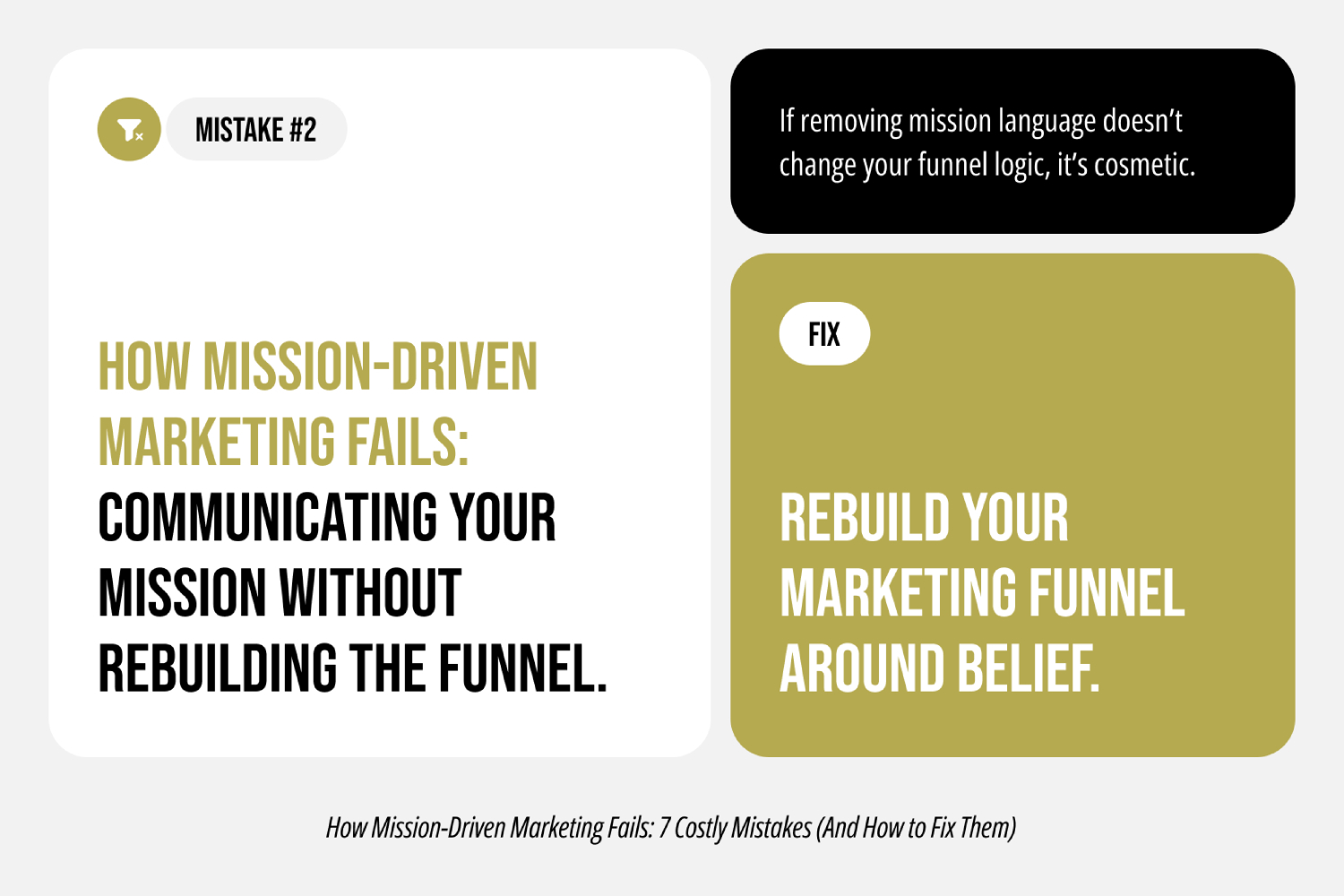
If your funnel works the same without mission language, the mission isn’t driving strategy.
Mission appears in headlines and campaigns. But often, the funnel logic remains unchanged. Lead scoring ignores mission alignment. Email nurture focuses on features rather than belief reinforcement. Paid campaigns emphasize performance claims disconnected from impact.
SEO prioritizes transactional queries while ignoring mission-aligned search intent.
If removing mission language would not change your funnel structure, then mission was cosmetic.
How to fix it: Map mission to every stage of the buyer journey. Align targeting, nurture logic, and content clustering around belief-driven intent. If you’re unsure how to structure your funnel so that mission reinforces nurture and conversion, our guide to creating a marketing funnel that nurtures leads and converts customers shows how to design each stage of the journey with intention — from awareness to decision — ensuring your mission is not just a tagline but a driver of behavioral momentum.
Mistake #1: Treating Mission as Branding Instead of a Growth Engine

Mission shouldn’t just inspire your brand. It should power your growth engine.
This is the most expensive mistake. Mission is often treated as tone, messaging, or visual identity. It shapes campaigns and creative — but not the growth system itself.
In today’s environment, discoverability determines credibility across:
- SEO strategy, search intent alignment, and content architecture
- Paid media positioning and audience targeting
- Social amplification and thought leadership
- Email sequencing and nurture logic
- Events, trade shows, and direct engagement
- PR narratives and media placement
- Sales enablement and proof assets
- Internal linking and structured authority
- GEO optimization for AI-driven search visibility
If mission does not directly influence how you prioritize channels, allocate budget, structure your funnel, design your proof hierarchy, and build discoverable authority, it remains branding — not a growth engine.
Thin content, fragmented messaging, inconsistent proof, and siloed execution weaken authority across the entire ecosystem. Competitors who engineer authority intentionally across channels will surface first, earn trust faster, and compound growth.
Authority isn’t declared. It’s engineered.
How to fix it:
Audit whether your mission influences real growth levers — targeting, budget allocation, channel mix, paid strategy, sales enablement, events, partnerships, SEO, and GEO. If you’re struggling to translate positioning into measurable growth, explore 5 Strategic Must-Haves for B2B Marketing That Actually Drive Growth, which outlines how investment, prioritization, and pipeline strategy must operate as one integrated system — not separate brand and performance functions.
If you’d like to see how mission becomes a growth engine rather than branding, explore how we supported a competitive technology sales organization, N3, by aligning positioning, website, social media, collaterals, and more into a unified authority system. When discoverability, proof, and targeting worked together, growth became structural — not episodic.
How to Build a Mission-Driven Growth Engine
For marketing teams and mid-sized businesses, the solution isn’t working harder. It’s redesigning how strategy flows through the organization. A mission-driven growth engine requires four structural shifts:
1. Appoint a Strategic Integrator, Not Just a Campaign Manager
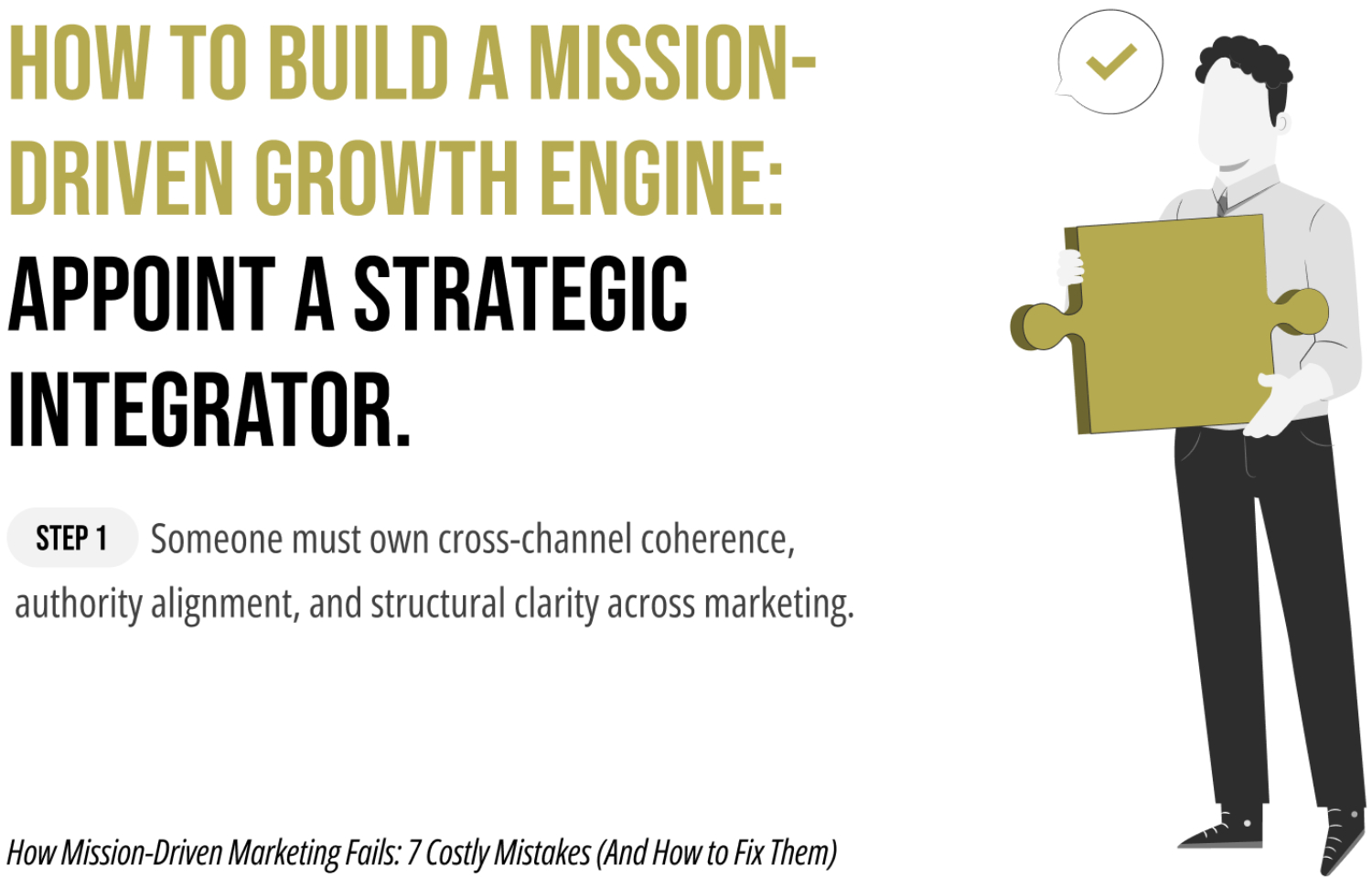
Mission-driven growth requires ownership of alignment across every channel.
Someone must own cross-channel coherence. This role isn’t about launching campaigns. It’s about asking:
- Are all channels reinforcing the same proof hierarchy?
- Is our targeting aligned with our mission-driven differentiation?
- Are insights from paid, sales, and search informing positioning?
- Are we compounding authority — or fragmenting it?
Without centralized integration, velocity replaces clarity.
2. Build a Trust Architecture Across the Entire Funnel
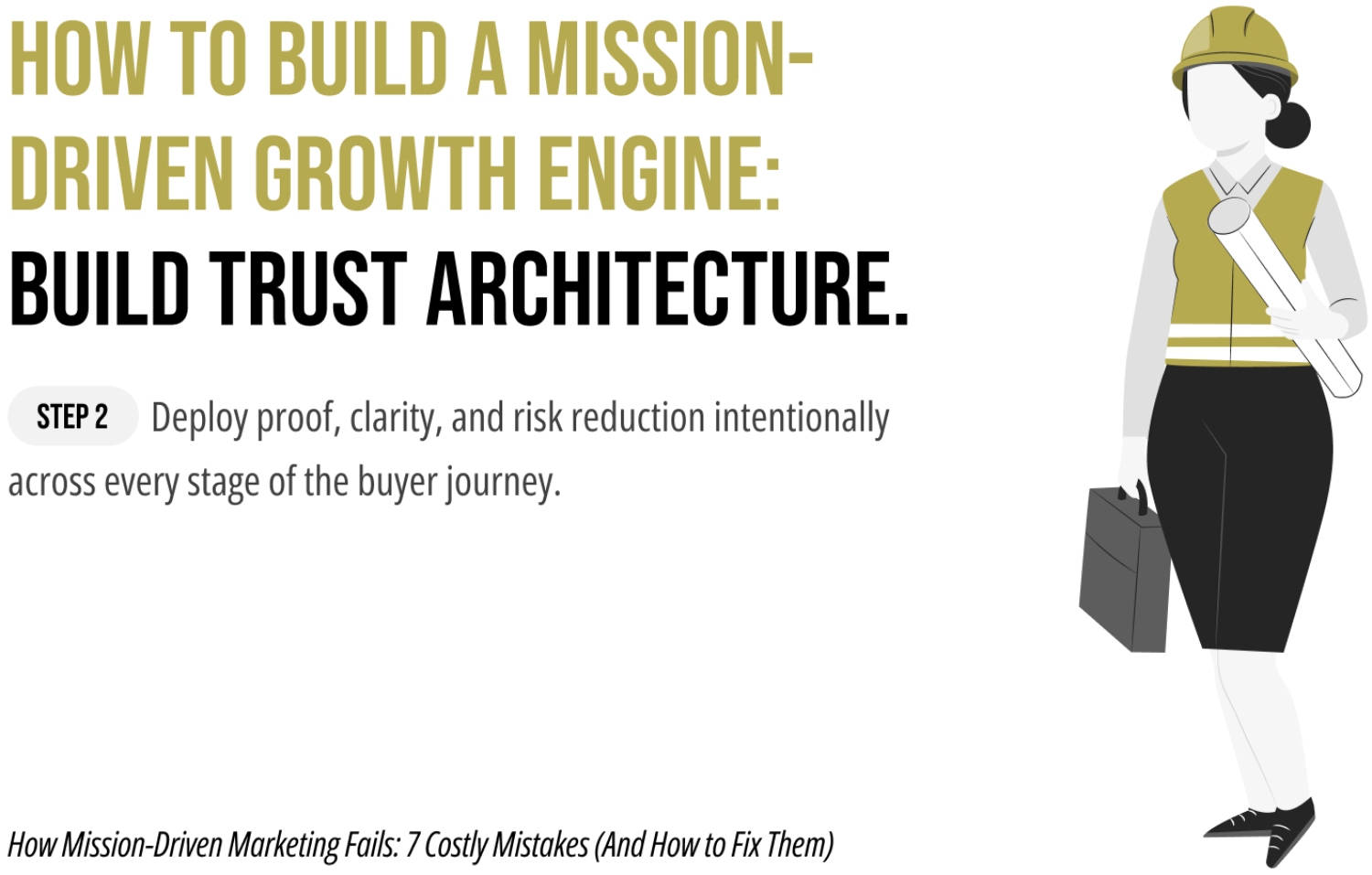
Trust isn’t accidental. It must be engineered across the buyer journey.
Map your buyer journey and identify where skepticism is highest. Then intentionally deploy:
- Outcome-driven proof
- Risk-reducing messaging
- Case studies aligned to objections
- Authority signals structured for SEO and GEO
- Consistent mission reinforcement across paid, owned, and earned media
Trust should be engineered at every stage — not added at the end.
3. Align Discoverability With Mission
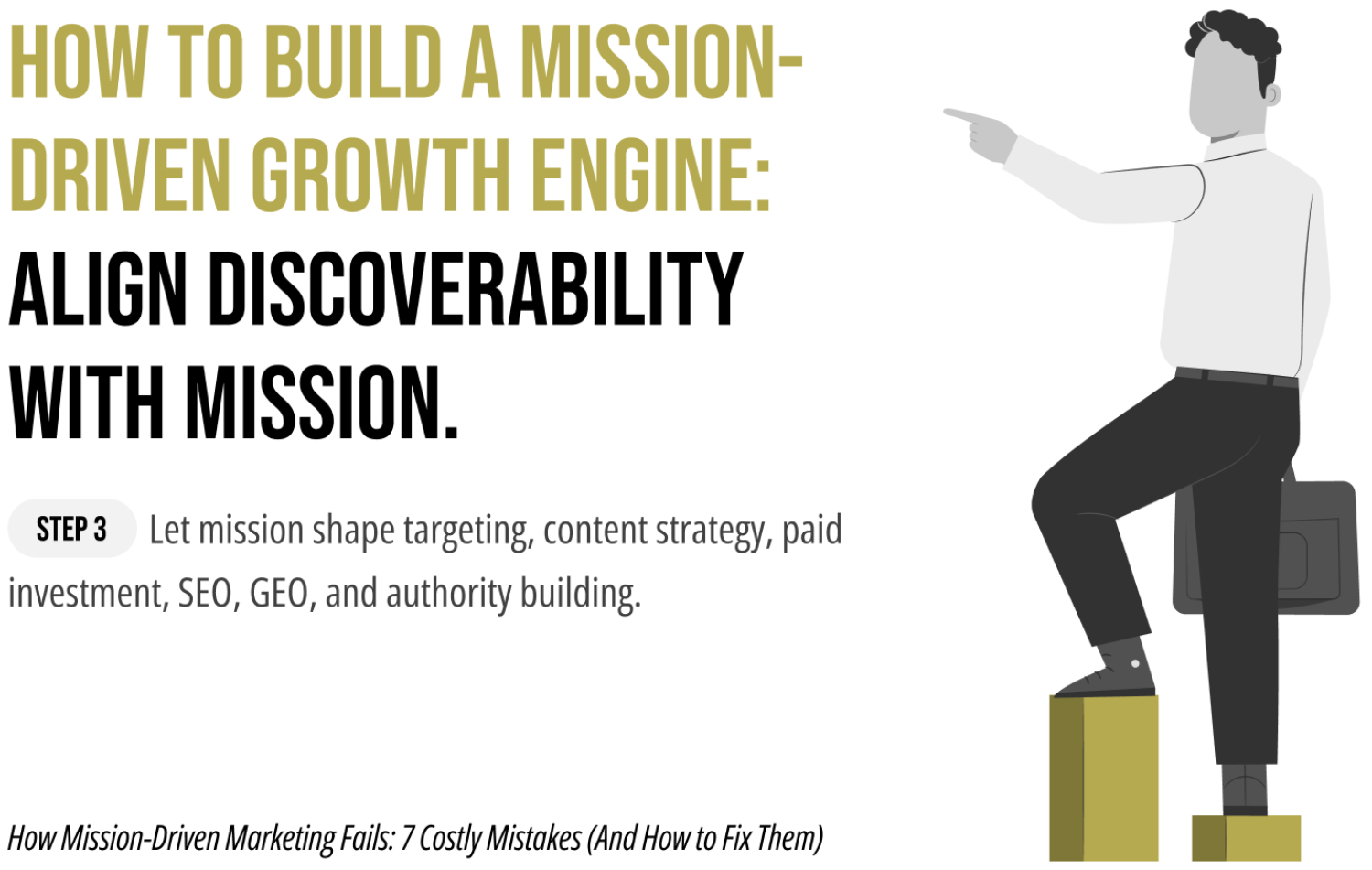
Your mission should shape how customers discover you.
Your mission must influence:
- Keyword prioritization
- Content clustering
- Paid targeting logic
- Media angles
- Event positioning
- Sales enablement materials
If mission doesn’t shape discoverability, competitors will own the narrative first. Authority must be built deliberately.
4. Schedule Structural Reviews — Not Just Performance Reviews
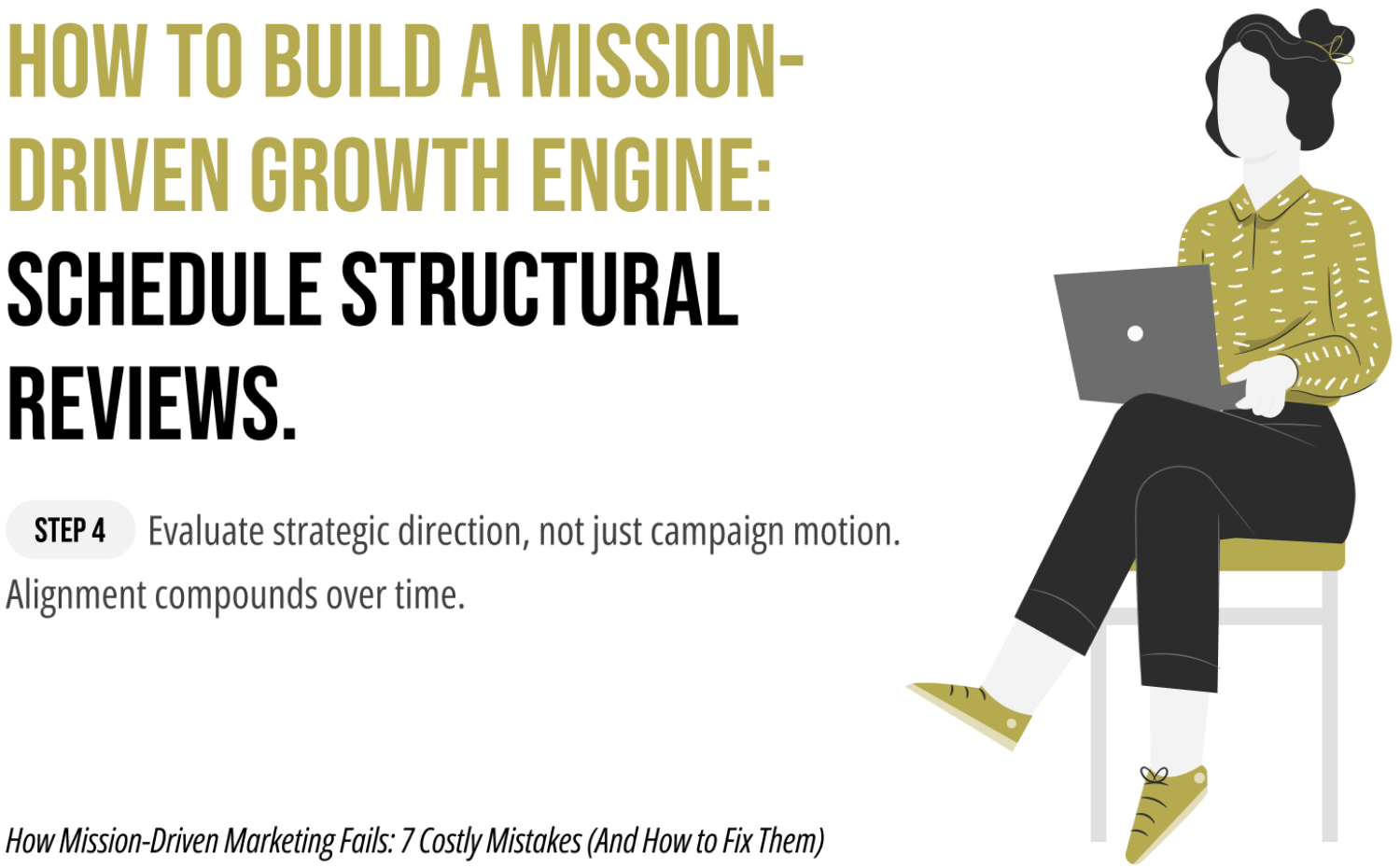
Growth compounds when strategy is reviewed — not just campaigns.
Campaign reports measure motion. Structural reviews measure direction. Quarterly, step back and evaluate:
- Are we reinforcing the same strategic pillars everywhere?
- Has audience perception shifted?
- Are we deepening authority in the right areas?
- Are we compounding proof — or repeating noise?
Mission doesn’t fail. The process around it does.
Mission-driven marketing fails in the process — not the purpose. When process becomes disciplined, mission becomes performance.
FAQs
Is mission-driven marketing only for nonprofits?
No. Any organization that competes on trust, credibility, or long-term brand equity benefits from a mission-driven marketing strategy. This applies to mid-sized businesses, professional services firms, B2B organizations, and impact-focused companies alike. Mission becomes a growth advantage when it is operationalized — not just communicated.
How do we close perception gaps between what we believe and what the market hears?
Perception gaps close through structured validation. Conduct stakeholder interviews, customer research, win/loss analysis, and feedback loops across sales and marketing. Compare internal positioning assumptions with external interpretation. Refine messaging based on evidence, not intent.
How does GEO impact mission-driven marketing?
Generative Engine Optimization influences whether your brand is summarized, cited, or recommended in AI-driven search. GEO rewards structured authority, comprehensive topic coverage, consistent terminology, and evidence-backed claims across channels. If your mission content lacks depth or cohesion, it is less likely to surface in generative results.
How do we make mission measurable?
Mission becomes measurable when it influences funnel outcomes. Track indicators such as conversion velocity, lead quality, sales cycle length, referral growth, organic visibility, AI citation presence, and customer retention. If mission alignment strengthens trust, those metrics should reflect it.
Can overtaxed marketing teams realistically implement this?
Yes — but not through more activity. It requires ownership and structure. Assign a strategic integrator responsible for cross-channel coherence, trust architecture, and SEO/GEO alignment. Schedule structural reviews in addition to campaign performance reviews. Growth comes from disciplined interpretation, not increased volume.
Turn Purpose Into Performance
Purpose becomes powerful when it’s engineered into a growth system.
Mission-driven marketing does not fail because teams lack heart. It fails when the process lacks structure. If you’re ready to build a mission-driven marketing strategy that integrates disciplined execution, SEO, GEO, and measurable growth, book a free 30-minute consult.
How strong is your
brand, really?
Take our short free audit to find out where your brand stands—and how to turn
strategy into impact. (It only takes 2 minutes—and can unlock the clarity your
brand needs to thrive.)
